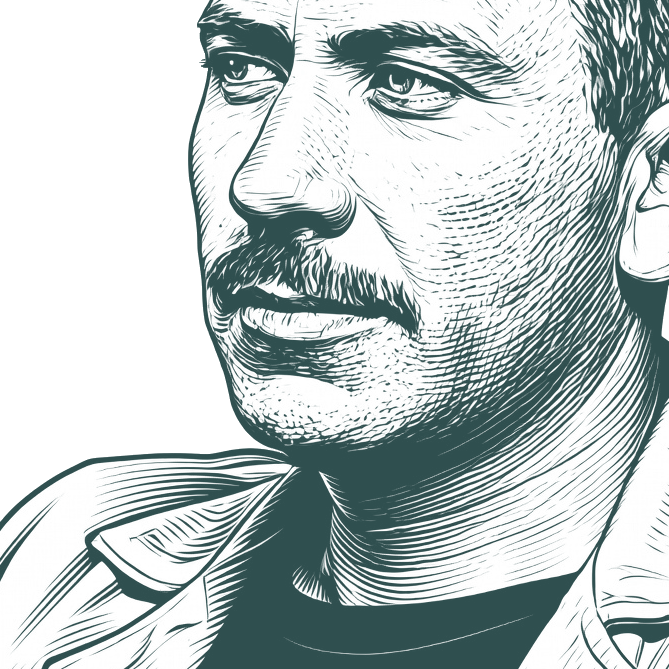
I seem to know that there’s a part of you missing. Some men can’t see the color green, but they may never know they can’t. I think you are only a par… - John Steinbeck
""
I seem to know that there’s a part of you missing. Some men can’t see the color green, but they may never know they can’t. I think you are only a part of a human. I can’t do anything about that. But I wonder whether you ever feel that something invisible is all around you. It would be horrible if you knew it was there and couldn’t see it or feel it.
English
Collect this quote
About
John Steinbeck
John Ernst Steinbeck Jr. (27 February 1902 – 20 December 1968) was an American writer. A recipient of the Nobel Prize for Literature in 1962, his works include the novella Of Mice and Men (1937) and the novel The Grapes of Wrath (1939, Pulitzer Prize for Fiction, 1940), both of which examine the lives of the working class and migrant workers during the Great Depression.
Biography information from
Wikiquote·
Portrait adapted from
Wikimedia Commons, McFadden Publications, Inc.; no photographer credited; photo likely the work of Sonya Noskowiak, as Steinbeck is wearing the same clothes from her 1935 studio session that produced the work shown here: https://www.si.edu/object/npg_NPG.2006.74 (Public domain / CC0)
Also Known As
Birth Name:
Jeffery Ernest Steinbeck
Alternative Names:
John Ernst Steinbeck, Jr.
•
John Ernst Steinbeck
•
John Ernest Steinbeck
•
John Ernst Steinbeck Jr
•
Steinbeck
Portrait from Wikimedia Commons. Credit: McFadden Publications, Inc.; no photographer credited; photo likely the work of Sonya Noskowiak, as Steinbeck is wearing the same clothes from her 1935 studio session that produced the work shown here: https://www.si.edu/object/npg_NPG.2006.74. Used under Public domain / CC0. Processed and styled by Quotewise.
Enhance Your Quote Experience
Enjoy ad-free browsing, unlimited collections, and advanced search features with Premium.
Thou mayest rule over sin,’ Lee. That’s it. I do not believe all men are destroyed. I can name you a dozen who were not, and they are the ones the world lives by. It is true of the spirit as it is true of battles — only the winners are remembered. Surely most men are destroyed, but there are others who like pillars of fire guide frightened men through the darkness. ‘Thou mayest, Thou mayest!’ What glory! It is true that we are weak and sick and quarrelsome, but if that is all we ever were, we would, millenniums ago, have disappeared from the face of the earth. A few remnants of fossilized jawbone, some broken teeth in strata of limestone, would be the only mark man would have left of his existence in the world. But the choice, Lee, the choice of winning! I had never understood it or accepted it before. Do you see now why I told Adam tonight? I exercised the choice. Maybe I was wrong, but by telling him I also forced him to live or get off the pot. What is that word, Lee?” “Timshel,” said Lee.