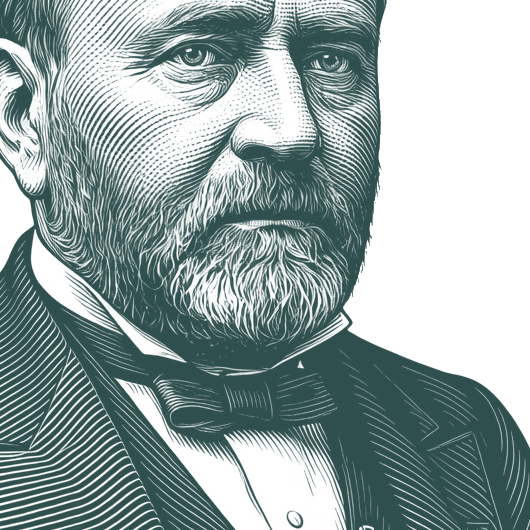
Ulysses S. Grant (27 April 1822 – 23 July 1885), born as Hiram Ulysses Grant, was the 18th president of the United States of America, from 1869 to 1877. As the Commanding General of the U.S. Army, Grant worked closely with U.S. President Abraham Lincoln to lead the U.S. Army to victory over the Confederacy in the American Civil War. He implemented Congressional Reconstruction, often at odds with Lincoln's successor, Andrew Johnson. Twice elected to the presidency, Grant led the Republicans in their effort to remove the vestiges of Confederate nationalism and slavery, protect the citizenship of African-Americans, and support U.S. economic prosperity.
Biography information from
Wikiquote·
Portrait adapted from
Wikimedia Commons, Brady-Handy Photograph Collection, Library of Congress (Public domain / CC0)
Also Known As
Birth Name:
Hiram Ulysses Grant
Also Known As:“Unconditional Surrender” Grant
Alternative Names:
General Grant
•
Ulysses Hiram Grant
•
Ulysses Grant
•
Ulysses S Grant
•
President Grant
•
U. S. Grant
•
U.S. Grant
•
Ulysses Simpson Grant
Portrait from Wikimedia Commons. Credit: Brady-Handy Photograph Collection, Library of Congress. Used under Public domain / CC0. Processed and styled by Quotewise.
Unlimited Quote Collections
Organize your favorite quotes without limits. Create themed collections for every occasion with Premium.
Money expended in a fine navy, not only adds to our security and tends to prevent war in the future, but is very material aid to our commerce with foreign nations in the meantime. Money spent upon sea-coast defences is spent among our own people, and all goes back again among the people.
He said to me that I might want an officer who had served with me in the West, mentioning Sherman specially, to take his place. If so, he begged me not to hesitate about making the change. He urged that the work before us was of such vast importance to the whole nation that the feeling or wishes of no one person should stand in the way of selecting the right men for all positions. For himself, he would serve to the best of his ability wherever placed. I assured him that I had no thought of substituting any one for him. As to Sherman, he could not be spared from the West. This incident gave me even a more favorable opinion of Meade than did his great victory at Gettysburg the July before. It is men who wait to be selected, and not those who seek, from whom we may always expect the most efficient service.
I had known General Lee in the old army, and had served with him in the Mexican War; but did not suppose, owing to the difference in our age and rank, that he would remember me, while I would more naturally remember him distinctly, because he was the chief of staff of General Scott in the Mexican War. When I had left camp that morning I had not expected so soon the result that was then taking place, and consequently was in rough garb. I was without a sword, as I usually was when on horseback on the field, and wore a soldier's blouse for a coat, with the shoulder straps of my rank to indicate to the army who I was. When I went into the house I found General Lee. We greeted each other, and after shaking hands took our seats. I had my staff with me, a good portion of whom were in the room during the whole of the interview. What General Lee's feelings were I do not know. As he was a man of much dignity, with an impassible face, it was impossible to say whether he felt inwardly glad that the end had finally come, or felt sad over the result, and was too manly to show it. Whatever his feelings, they were entirely concealed from my observation; but my own feelings, which had been quite jubilant on the receipt of his letter, were sad and depressed. I felt like anything rather than rejoicing at the downfall of a foe who had fought so long and valiantly, and had suffered so much for a cause, though that cause was, I believe, one of the worst for which a people ever fought, and one for which there was the least excuse. I do not question, however, the sincerity of the great mass of those who were opposed to us.