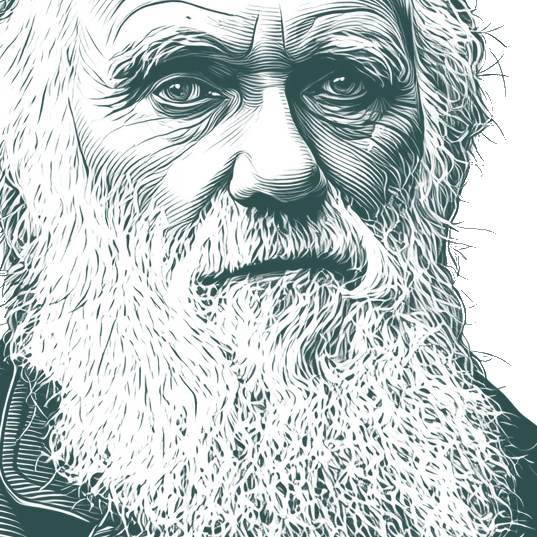
A moral being is one who is capable of reflecting on his past actions and their motives — of approving of some and disapproving of others. - Charles Darwin
""
A moral being is one who is capable of reflecting on his past actions and their motives — of approving of some and disapproving of others.
Charles Robert Darwin (12 February 1809 – 19 April 1882) was an English naturalist, geologist and biologist, best known for his contributions to the science of evolution. He proposed that evolution could be explained in part through natural and sexual selection. Prompted by awareness that Alfred Russel Wallace was developing similar theories he published his own sooner than he had originally intended. This theory is now an integral component of biological science.
Biography information from
Wikiquote·
Portrait adapted from
Wikimedia Commons, Herbert Rose Barraud (Public domain / CC0)
Also Known As
Birth Name:
Charles Robert Darwin
Alternative Names:
Charles R. Darwin
•
C. R. Darwin
•
Darwin
•
C.R. Darwin
•
CR Darwin
I hate a Barnacle as no man ever did before, not even a Sailor in a slow-sailing ship.
"The only distinct meaning of the word 'natural' is STATED, FIXED or SETTLED; since what is natural as much requires and presupposes an intelligent agent to render it so, i.e., to effect it continually or at stated times, as what is supernatural or miraculous does to effect it for once." — Butler: "Analogy of Revealed Religion".
Go Premium
Support Quotewise while enjoying an ad-free experience and premium features.
As man advances in civilisation, and small tribes are united into larger communities, the simplest reason would tell each individual that he ought to extend his social instincts and sympathies to all the members of the same nation, though personally unknown to him. This point being once reached, there is only an artificial barrier to prevent his sympathies extending to the men of all nations and races. If, indeed, such men are separated from him by great differences in appearance or habits, experience unfortunately shews us how long it is before we look at them as our fellow-creatures. Sympathy beyond the confines of man, that is humanity to the lower animals, seems to be one of the latest moral acquisitions. It is apparently unfelt by savages, except towards their pets. How little the old Romans knew of it is shewn by their abhorrent gladiatorial exhibitions. The very idea of humanity, as far as I could observe, was new to most of the Gauchos of the Pampas. This virtue, one of the noblest with which man is endowed, seems to arise incidentally from our sympathies becoming more tender and more widely diffused, until they are extended to all sentient beings. As soon as this virtue is honoured and practised by some few men, it spreads through instruction and example to the young, and eventually through public opinion.