Among these I should place, first, the broadly tolerant attitude that has been a characteristic of this country. I use the word in its most inclusive… - Calvin Coolidge
""
Among these I should place, first, the broadly tolerant attitude that has been a characteristic of this country. I use the word in its most inclusive sense, to cover tolerance of religious opinion, tolerance in politics, tolerance in social relationships; in general, the liberal attitude of every citizen toward his fellows. It is this factor which has preserved to all of us that equality of opportunity which enables every American to become the architect of whatever fortune he deserves.
English
Collect this quote
About
Calvin Coolidge
John Calvin Coolidge Jr. (4 July 1872 – 5 January 1933) was the 30th president of the United States (1923–29). A Republican lawyer from Vermont, Coolidge worked his way up the ladder of Massachusetts state politics, eventually becoming governor of that state. His response to the Boston Police Strike of 1919 thrust him into the national spotlight and gave him a reputation as a man of decisive action. Soon after, he was elected as the 29th vice president in 1920 and succeeded to the presidency upon the sudden death of Warren G. Harding in 1923. Elected in his own right in 1924, he gained a reputation as a small-government conservative.
Biography information from
Wikiquote·
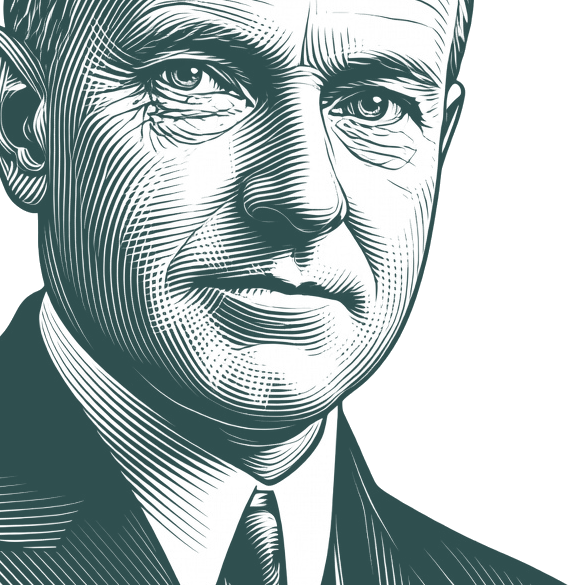
Portrait adapted from
Wikimedia Commons, Harris & Ewing (Public domain / CC0)
Also Known As
Birth Name:
John Calvin
Alternative Names:
John Calvin Coolidge Jr.
•
John Calvin Coolidge
•
President Coolidge
•
J. C. Coolidge
•
C. Coolidge
•
Silent Cal
•
Silent Cal Coolidge
Wealth comes from industry and from the hard experience of human toil. To dissipate it in waste and extravagance is disloyalty to humanity.
After more than five years of the bitterest war in human experience, the last great stronghold of force surrendering to the demands of America and her allies agreed to cast aside the sword and live under the law. America decided that the path of the Mayflower should not be closed. She decided to sail the seas. She decided to sail not under an Edict of Potsdam, cramped in narrow lands, seeking safety in unarmed merchant men painted in fantastic hues as the badge of an infinite servitude; but she decided to sail under the ancient Declaration of Independence, choosing her own course, maintaining security by the guns of her ships of the LINE, flying at the mast the stars and stripes forever, the emblem of a militant liberty.
Unlimited Quote Collections
Organize your favorite quotes without limits. Create themed collections for every occasion with Premium.
But having invited them here, having accepted their great and varied contributions to the building of the Nation, it is for us to maintain in all good faith those liberal institutions and traditions which have been so productive of good. The bringing together of all these different national, racial, religious, and cultural elements has made our country a kind of composite of the rest of the world, and we can render no greater service than by demonstrating the possibility of harmonious cooperation among so many various groups. Every one of them has something characteristic and significant of great value to cast into the common fund of our material, intellectual, and spiritual resources.