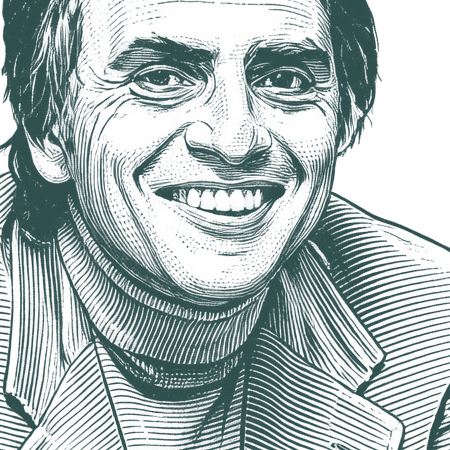
Anything you don't understand, you attribute to God. God for you is where you sweep away all the mysteries of the world, all the challenges to our in… - Carl Sagan
""
Anything you don't understand, you attribute to God. God for you is where you sweep away all the mysteries of the world, all the challenges to our intelligence. You simply turn your mind off and say God did it.
Carl Edward Sagan (9 November 1934 – 20 December 1996) was an American astronomer, planetary scientist, cosmologist, astrophysicist, astrobiologist, author, and science communicator. His best known scientific contribution is research on extraterrestrial life, including experimental demonstration of the production of amino acids from basic chemicals by radiation. Sagan assembled the first physical messages sent into space, the Pioneer plaque and the Voyager Golden Record, universal messages that could potentially be understood by any extraterrestrial intelligence that might find them. Sagan argued the hypothesis, accepted since, that the high surface temperatures of Venus can be attributed to, and calculated using, the greenhouse effect. He testified to the US Congress in 1985 that the greenhouse effect will change the earth's climate system.
Biography information from
Wikiquote·
Portrait adapted from
Wikimedia Commons, NASA/JPL (Public domain / CC0)
Also Known As
Native Name:
Carl Edward Sagan
Alternative Names:
Sagan
•
Carl E. Sagan
•
Carl E Sagan
•
C. E. Sagan
•
C.E. Sagan
•
C E Sagan
•
C. Sagan
•
C Sagan
•
Sagan C
•
Sagan C.
•
Sagan C. E.
•
Sagan CE
I would rather understand one cause than be King of Persia. — Democritus of Abdera If a faithful account was rendered of Man’s ideas upon Divinity, he would be obliged to acknowledge, that for the most part the word “gods” has been used to express the concealed, remote, unknown causes of the effects he witnessed; that he applies this term when the spring of the natural, the source of known causes, ceases to be visible: as soon as he loses the thread of these causes, or as soon as his mind can no longer follow the chain, he solves the difficulty, terminates his research, by ascribing it to his gods … When, therefore, he ascribes to his gods the production of some phenomenon … does he, in fact, do any thing more than substitute for the darkness of his own mind, a sound to which he has been accustomed to listen with reverential awe? — Paul Heinrich Dietrich, Baron von Holbach, Système de la Nature, London, 1770 When
[When a religious couple wrote to Sagan about fulfilled prophecies, he wrote back in May 1996:]
If ‘fulfilled prophecy’ is your criterion, why do you not believe in materialistic science, which has an unparalleled record of fulfilled prophecy? Consider, for example, eclipses.