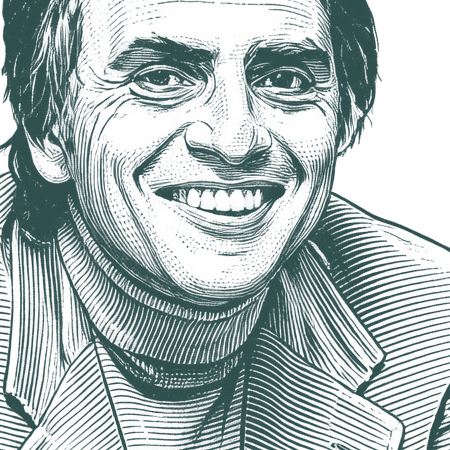
Avoidable human misery is more often caused not so much by stupidity as by ignorance, particularly our ignorance about ourselves. - Carl Sagan

" "

Avoidable human misery is more often caused not so much by stupidity as by ignorance, particularly our ignorance about ourselves.

English
Collect this quote

About Carl Sagan

Carl Edward Sagan (9 November 1934 – 20 December 1996) was an American astronomer, planetary scientist, cosmologist, astrophysicist, astrobiologist, author, and science communicator. His best known scientific contribution is research on extraterrestrial life, including experimental demonstration of the production of amino acids from basic chemicals by radiation. Sagan assembled the first physical messages sent into space, the Pioneer plaque and the Voyager Golden Record, universal messages that could potentially be understood by any extraterrestrial intelligence that might find them. Sagan argued the hypothesis, accepted since, that the high surface temperatures of Venus can be attributed to, and calculated using, the greenhouse effect. He testified to the US Congress in 1985 that the greenhouse effect will change the earth's climate system.

Biography information from Wikiquote

Also Known As

Native Name: Carl Edward Sagan
Alternative Names: Sagan Carl E. Sagan Carl E Sagan C. E. Sagan C.E. Sagan C E Sagan C. Sagan C Sagan Sagan C Sagan C. Sagan C. E. Sagan CE
Works in ChatGPT, Claude, or Any AI

Add semantic quote search to your AI assistant via MCP. One command setup.

Related quotes. More quotes will automatically load as you scroll down, or you can use the load more buttons.

Additional quotes by Carl Sagan

La búsqueda de configuraciones sin análisis crítico y la ostentación de un rígido escepticismo sin la búsqueda de configuraciones son las antípodas de una ciencia incompleta. La búsqueda efectiva del saber requiere la concurrencia de ambas funciones.

- Ten thousand years ago, when we were divided into many small groups, the propensities may have served our species well. We can understand why they should be easy to evoke, why they are stock in trade of every demagogue and hack politician. But we cannot wait for natural selection to further mitigate these ancient primate algorithms. That would take too long. We must work with what tools we have – to understand who we are, how we got to be that way, and how to transcend our deficiencies. Then we can begin to create a society less apt to bring out the worst in us.

PREMIUM FEATURE
Advanced Search Filters

Filter search results by source, date, and more with our premium search tools.

In our earliest history, so far as we can tell, individuals held to an allegiance toward their immediate tribal group, which may have numbered no more than ten or twenty individuals, all of whom were related by consanguinity. As time went on, the need for cooperative behavior — in the hunting of large animals or large herds, in agriculture, and in the development of cities — forced human beings into larger and larger groups. The group that was identified with, the tribal unit, enlarged at each stage of evolution. Today, a particular instant in the 4.5-billion-year history of Earth and in the several-million-year history of mankind, most human beings owe their primary allegiance to the nation-state (although some of the most dangerous political problems still arise from tribal conflicts involving smaller population units). Many visionary leaders have imagined a time when the allegiance of an individual human being is not to his particular nation-state, religion, race, or economic group, but to mankind as a whole; when the benefit to a human being of another sex, race, religion, or political persuasion ten thousand miles away is as precious to us as to our neighbor or our brother. The trend is in this direction, but it is agonizingly slow. There is a serious question whether such a global self-identification of mankind can be achieved before we destroy ourselves with the technological forces our intelligence has unleashed.

Loading...