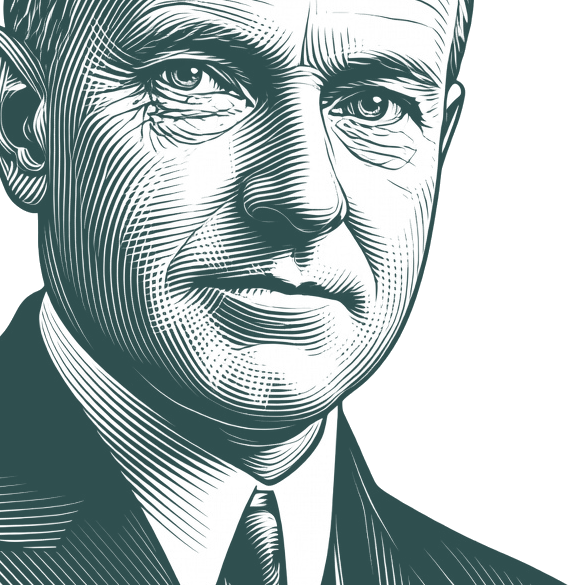
Waterways. Meantime our internal development should go on. Provision should be made for flood control of such rivers as the Mississippi and the Color… - Calvin Coolidge
""
Waterways. Meantime our internal development should go on. Provision should be made for flood control of such rivers as the Mississippi and the Colorado, and for the opening up of our inland waterways to commerce. Consideration is due to the project of better navigation from the Great Lakes to the Gulf. Every effort is being made to promote an agreement with Canada to build the, St. Lawrence waterway. There are pending before the Congress bills for further development of the Mississippi Basin, for the taking over of the Cape Cod Canal in accordance with a moral obligation which seems to have been incurred during the war, and for the improvement of harbors on both the Pacific and the Atlantic coasts. While this last should be divested of some of its projects and we must proceed slowly, these bills in general have my approval. Such works are productive of wealth and in the long run tend to a reduction of the tax burden.
English
Collect this quote
About
Calvin Coolidge
John Calvin Coolidge Jr. (4 July 1872 – 5 January 1933) was the 30th president of the United States (1923–29). A Republican lawyer from Vermont, Coolidge worked his way up the ladder of Massachusetts state politics, eventually becoming governor of that state. His response to the Boston Police Strike of 1919 thrust him into the national spotlight and gave him a reputation as a man of decisive action. Soon after, he was elected as the 29th vice president in 1920 and succeeded to the presidency upon the sudden death of Warren G. Harding in 1923. Elected in his own right in 1924, he gained a reputation as a small-government conservative.
Biography information from
Wikiquote·
Portrait adapted from
Wikimedia Commons, Harris & Ewing (Public domain / CC0)
Also Known As
Birth Name:
John Calvin
Alternative Names:
John Calvin Coolidge Jr.
•
John Calvin Coolidge
•
President Coolidge
•
J. C. Coolidge
•
C. Coolidge
•
Silent Cal
•
Silent Cal Coolidge
In dealing with our military problems there is one principle that is exceedingly important. Our institutions are founded not on military power but on civil authority. We are irrevocably committed to the theory of a government by the people. We have our constitutions and our laws, our executives, our legislatures, and our courts, but ultimately we are governed by public opinion. Our forefathers had seen so much of militarism, and suffered so much from it, that they desired to banish it forever. They believed and declared in at least one of their State constitutions that the military power should be subordinate to and governed by the civil authority. It is for this reason that any organization of men in the military service bent on inflaming the public mind for the purpose of forcing Government action through the pressure of public opinion is an exceedingly dangerous undertaking and precedent. This is so whatever form it might take, whether it be for the purpose of influencing the Executive, the legislature, or the heads of departments. It is for the civil authority to determine what appropriations shall be granted, what appointments shall be made, and what rules shall be adopted for the conduct of its armed forces. Whenever the military power starts dictating to the civil authority, by whatsoever means adopted, the liberties of the country are beginning to end. National defense should at all times be supported, but any form of militarism should be resisted.
The thirteen Colonies were not unaware of the difficulties which these problems presented. We shall find a great deal of wisdom in the method by which they dealt with them. When they were finally separated from Great Britain, the allegiance of their citizens was not to the Nation, for there was none. It was to the States. For the conduct of the war there had been a voluntary confederacy loosely constructed and practically impotent. Continuing after peace was made, when the common peril which had been its chief motive no longer existed, it grew weaker and weaker. Each of the States could have insisted on an entirely separate and independent existence, having full authority over both their internal and external affairs, sovereign in every way. But such sovereignty would have been a vain and empty thing. It would have been unsupported by adequate resources either of property or population, without a real national spirit; ready to fall prey to foreign intrigue or foreign conquest. That kind of sovereignty meant but little. It had no substance in it. The people and their leaders naturally sought for a larger, more inspiring ideal. They realized that while to be a citizen of a State meant something, it meant a great deal more if that State were a part of a national union. The establishment of a Federal Constitution giving power and authority to create a real National Government did not in the end mean a detriment, but rather an increment to the sovereignty of the several States. Under the Constitution there was brought into being a new relationship, which did not detract from but added to the power and the position of each State. It is true that they surrendered the privilege of performing certain acts for themselves, like the regulation of commerce and the maintenance of foreign relations, but in becoming a part of the Union they received more than they gave.
PREMIUM FEATURE
Advanced Search Filters
Filter search results by source, date, and more with our premium search tools.
In my message last year I emphasized the necessity for further legislation with a view to expediting the consolidation of our rail ways into larger systems. The principle of Government control of rates and profits, now thoroughly embedded in our governmental attitude toward natural monopolies such as the railways, at once eliminates the need of competition by small units as a method of rate adjustment. Competition must be preserved as a stimulus to service , but this will exist and can be increased under enlarged systems. Consequently the consolidation of the railways into larger units for the purpose of securing the substantial values to the public which will come from larger operation has been the logical conclusion of Congress in its previous enactments, and is also supported by the best opinion in the country. Such consolidation will assure not only a greater element of competition as to service, but it will afford economy in operation, greater stability in railway earnings, and more economical financing. It opens large possibilities of better equalization of rates between different classes of traffic so as to relieve undue burdens upon agricultural products and raw materials generally, which are now not possible without ruin to small units owing to the lack of diversity of traffic. It would also tend to equalize earnings in such fashion as to reduce the importance of section 15A, at which criticism, often misapplied, has been directed. A smaller number of units would offer less difficulties in labor adjustments and would contribute much to the, solution of terminal difficulties.