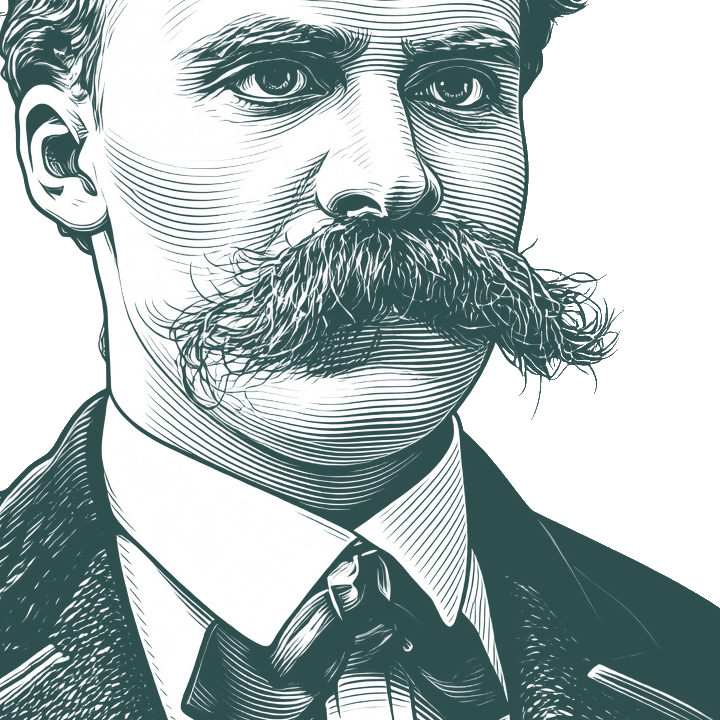
What, then, is truth? A mobile army of metaphors, metonyms, and anthropomorphisms – in short, a sum of human relations, which have been enhanced, tra… - Friedrich Nietzsche
""
What, then, is truth? A mobile army of metaphors, metonyms, and anthropomorphisms – in short, a sum of human relations, which have been enhanced, transposed, and embellished poetically and rhetorically, and which after long use seem firm, canonical, and obligatory to a people: truths are illusions about which one has forgotten that this is what they are; metaphors which are worn out and without sensuous power; coins which have lost their pictures and now matter only as metal, no longer as coins.
Friedrich Wilhelm Nietzsche (15 October 1844 – 25 August 1900) was a German philosopher, cultural critic, composer, poet, writer, and philologist whose work has exerted a profound influence on modern intellectual history. His critiques of contemporary culture, religion, and philosophy centered on a basic question regarding the foundation of values and morality.
Biography information from
Wikiquote·
Portrait adapted from
Wikimedia Commons, Friedrich Hermann Hartmann (Public domain / CC0)
Also Known As
Alternative Names:
Friedrich Wilhelm Nietzsche
•
Nietzsche
Another thing is war. I am naturally warlike. Attacking is one of my instincts. Being able to be an enemy, being an enemy — these require a strong nature, perhaps; in any case every strong nature presupposes them. It needs resistances, so it seeks resistance: aggressive pathos is just as integrally necessary to strength as the feeling of revenge and reaction is to weakness. Woman, forinstance, is vengeful: that is a condition of her weakness, as is her sensitivity to other people’s afflictions. — The strength of anattacker can in a way be gauged by the opposition he requires; allgrowth makes itself manifest by searching out a more powerful opponent — or problem: for a philosopher who is warlike challenges problems to duels, too. The task is not to master all resistances, but only those against which one has to pit one’s entire strength, suppleness, and mastery-at-arms — opponents who are equal...
In conversation we are sometimes confused by the tone of our own voice, and mislead to make assertions that do not at all correspond to our opinions.
Go Premium
Support Quotewise while enjoying an ad-free experience and premium features.
No one is accountable for existing at all, or for being constituted as he is, or for living in the circumstances and surroundings in which he lives. The fatality of his nature cannot be disentangled from the fatality of all that which has been and will be. He is not the result of a special design, a will, a purpose; he is not the subject of an attempt to attain an 'ideal of man' or an 'ideal of happiness' or an 'ideal of morality' — it is absurd to want to hand over his nature to some purpose or other. We invented the concept 'purpose': in reality purpose is lacking...One is necessary, one is a piece of fate, one belongs to the whole, one is in the whole — there exists nothing which could judge, measure, compare, condemn our being, for that would be to judge, measure, condemn the whole...