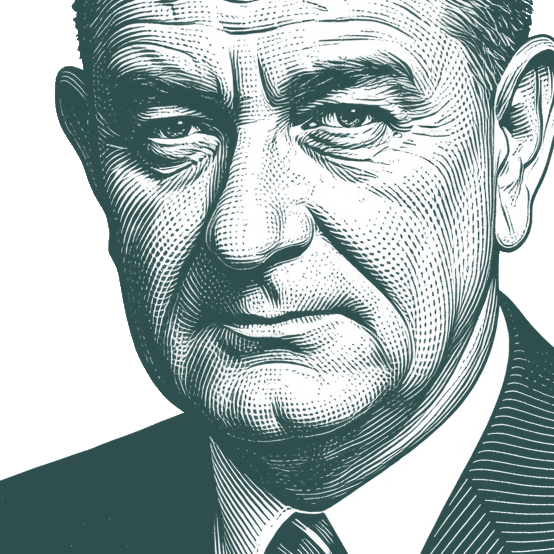
For at the real heart of battle for equality is a deep-seated belief in the democratic process. Equality depends not on the force of arms or tear gas… - Lyndon B. Johnson
""
For at the real heart of battle for equality is a deep-seated belief in the democratic process. Equality depends not on the force of arms or tear gas but upon the force of moral right; not on recourse to violence but on respect for law and order.
Lyndon Baines Johnson (27 August 1908 – 22 January 1973), often referred to by his initials LBJ, was an American politician. After a long career in U.S. legislatures, Johnson became the vice president of the United States of America under John F. Kennedy, from 1961 to 1963. A Democrat, Johnson became the 36th U.S. president in 1963, after Kennedy's assassination. He served in the role until 1969.
Portrait adapted from
Wikimedia Commons, Arnold Newman (Public domain / CC0)
Also Known As
Native Name:
Lyndon Baines Johnson
Also Known As:LBJ
Alternative Names:
Lyndon Johnson
•
President Johnson
•
L. B. Johnson
As we maintain the vigil of peace, we must remember that justice is a vigil, too — a vigil we must keep in our own streets and schools and among the lives of all our people — so that those who died here on their native soil shall not have died in vain.
I would like briefly, today, to mention three problems which menace man's welfare and will threaten it even when armed destruction and war are things of the past. They are the problems of poverty, of disease, and of diminishing natural resources. First is the problem of poverty--the growing division between the rich and poor nations. Today the per capita product of the developed countries is $1,730 a year. In the developing countries it is $143. And the gap is widening, not narrowing. Our own growth must continue. But we must find ways to step up the growth of others or we will be an increasingly isolated island of wealth in the midst of mounting misery. Second is man's struggle against disease, the focal point in his war to control the destructive forces of nature. Each year 3 million people die from tuberculosis. Each year 5 million die from dysentery, 500,000 from measles. In some countries one-sixth of the entire population suffer from leprosy. Yet, we have the knowledge to reduce the toll of these diseases, and to avert millions of separate tragedies of needless death and suffering. Third is the need to develop new resources, and new ways to use existing resources. It has been estimated that if everyone in the world were to rise to the level of living of the United States we would then have to extract about 20 billion tons of iron, 300 million tons of copper, 300 million tons of lead, and 200 million tons of zinc. These totals are well over 100 times the world's present annual rate of production.
Franklin Roosevelt talked about the one-third that were ill clad and ill fed and ill housed. After working 30 years with your help and your crusades and your radical editorials and all of those things, we have it down to one-fifth, but we still have got 20 percent, 1 out of every 5, that are in the poverty group. Twenty years ago, 5 percent over a 10-year period, coming out from 1942 to 1952, and from 1952 to 1962 it was 3 percent, and now it is 1 percent that is coming out--1 percent a year. From 1937 to 1947 it was 5 percent, 1947 to 1953 it was 3 percent, 1953 to 1963 it is 1 percent. Now it is getting a lot more difficult in this IBM age for those people that have no training, that live on the other side of the tracks--it is getting a lot more difficult for them to get out and cross the tracks and get out of that poverty classification. You have to help them by this poverty program that will provide them with training. Forty-nine percent--1 out of every 2 boys we draft has to be sent home because he is physically or mentally unqualified. That is the kind of folks you are raising. If I had to do that with my calves, I would go broke every year. If I out of every 2 of my calves was born and I had to have rejects, I couldn't make it. So we begin this poverty war from a position of unmatched prosperity, with national abundance. We have just concluded the most productive and prosperous quarter on record. I had the figures here a minute ago. I wanted to give them to you.