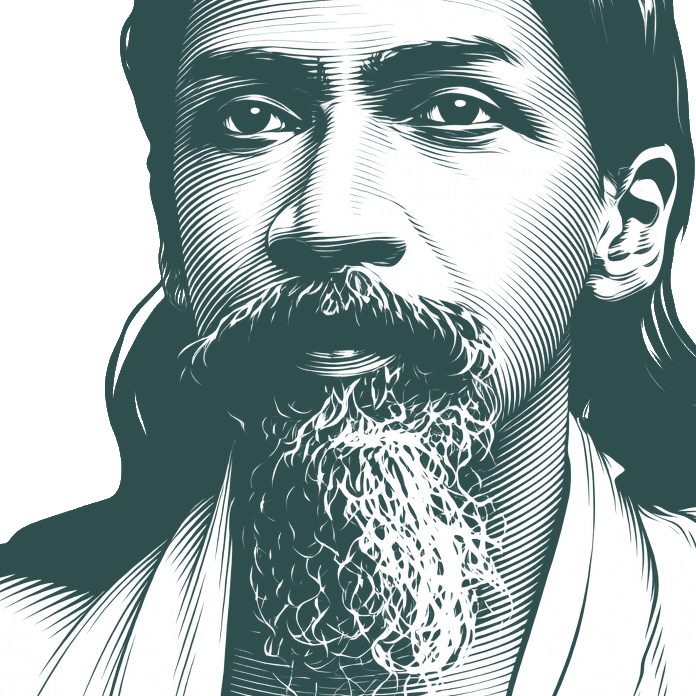
No doubt, hatred and cursing are not the proper attitude. It is true also that to look upon all things and all people with a calm and clear vision, t… - Aurobindo Ghosh
""
No doubt, hatred and cursing are not the proper attitude. It is true also that to look upon all things and all people with a calm and clear vision, to be uninvolved and impartial in one's judgments is a quite proper yogic attitude. A condition of perfect samata [equanimity] can be established in which one sees all as equal, friends and enemies included, and is not disturbed by what men do or by what happens. The question is whether this is all that is demanded from us. If so, then the general attitude will be of a neutral indifference to everything. But the Gita, which strongly insists on a perfect and absolute samata, goes on to say, 'Fight, destroy the adversary, conquer.' If there is no kind of general action wanted, no loyalty to Truth as against Falsehood except for one's personal sadhana, no will for the Truth to conquer, then the samata of indifference will suffice. But here there is a work to be done, a Truth to be established against which immense forces are arrayed, invisible forces which can use visible things and persons and actions for their instruments. If one is among the disciples, the seekers of this Truth, one has to take sides for the Truth, to stand against the forces that attack it and seek to stifle it. Arjuna wanted not to stand for either side, to refuse any action of hostility even against assailants; Sri Krishna, who insisted so much on samata, strongly rebuked his attitude and insisted equally on his fighting the adversary. 'Have samata,' he said, 'and seeing clearly the Truth, fight.' Therefore to take sides with the Truth and to refuse to concede anything to the Falsehood that attacks, to be unflinchingly loyal and against the hostiles and the attackers, is not inconsistent with equality.... It is a spiritual battle inward and outward; by neutrality and compromise or even passivity one may allow the enemy force to pass and crush down the Truth and its children. If you look at it from this point, you will see that if the inner spiritual equality is right, the active loyalty and firm taking of sides is as right, and the two cannot be incompatible.
English
Collect this quote
About
Aurobindo Ghosh
Sri Aurobindo [born Aravinda Akroyd Ghose] (15 August 1872 – 5 December 1950) was an Indian nationalist, scholar, poet, mystic, philosopher, yogi and guru, who developed concepts of human progress and spiritual evolution. With the help of his spiritual collaborator, Mirra Alfassa, he founded the Sri Aurobindo Ashram.
Biography information from
Wikiquote·
Portrait adapted from
Wikimedia Commons, Rudolf 1922 (Public domain / CC0)
Also Known As
Native Name:
অরবিন্দ ঘোষ
Alternative Names:
Sri Aurobindo Ghose
•
Sri Orobindo
•
Orobindo Ghosh
•
Shri Aurobindo
•
Aurobindo Ghose
•
Sri Aurobindo
•
Aurobindo
•
Aravinda Ackroyd Ghose
•
A.A.Ghosh
•
A.G.
•
Maharshi Aravind Babu
O soldier and hero of God, where for thee is sorrow or shame or suffering? For thy life is a glory, thy deeds a consecration, victory thy apotheosis, defeat thy triumph.
If you expect manners from modern newspapers you will be sorely disappointed in these democratic days. It is one of the blessings of modern democracy? If you were in America and did not give any interview, even then they would invent one? The press is a public institution; formerly, it was something dignified, but now the newspapers are the correct measure of the futility of human life.... It is the same with all other modern things... the press, the theatre, the radio; they drag down everything to the level of the crowd.... They succeed only if they can pamper the common man's tastes.... It is the same old question of the mass being pulled up by something higher. But, as it always happens, instead of being pulled up it is the mass that pulls everything down to its level....
Try QuoteGPT
Chat naturally about what you need. Each answer links back to real quotes with citations.
How can there be a religion which has no rigid dogmas demanding belief on pain of eternal damnation, no theological postulates, even no fixed theology, no credo distinguishing it from antagonistic or rival religions? How can there be a religion which has no papal head, no governing ecclesiastic body, no church, chapel or congregational system, no binding religious form of any kind obligatory on all its adherents, no one administration and discipline? For the Hindu priests are mere ceremonial officiants without any ecclesiastical authority or disciplinary powers and the Pundits are mere interpreters of the Shastra, not the lawgivers of the religion or its rulers. How again can Hinduism be called a religion when it admits all beliefs, allowing even a kind of high-reaching atheism and agnosticism and permits all possible spiritual experiences, all kinds of religious adventures? The only thing fixed, rigid, positive, clear is the social law, and even that varies in different castes, regions, communities. The caste rules and not the Church; but even the caste cannot punish a man for his beliefs, ban heterodoxy or prevent his following a new revolutionary doctrine or a new spiritual leader.