Unlimited Quote Collections
Organize your favorite quotes without limits. Create themed collections for every occasion with Premium.
" "Man is a talkative and religious ape. He is an ape, but with a much greater amount of enterprise and with a greater likelihood of being found in every variety of climate. Like the anthropoid, man has a bald face and an obsolete tail. But he is distinguished from his arboreal relative by his arrogant bearing, his skilled larynx, and especially by the satisfaction he experiences in the contemplation of the image which appears when he looks in a mirror.
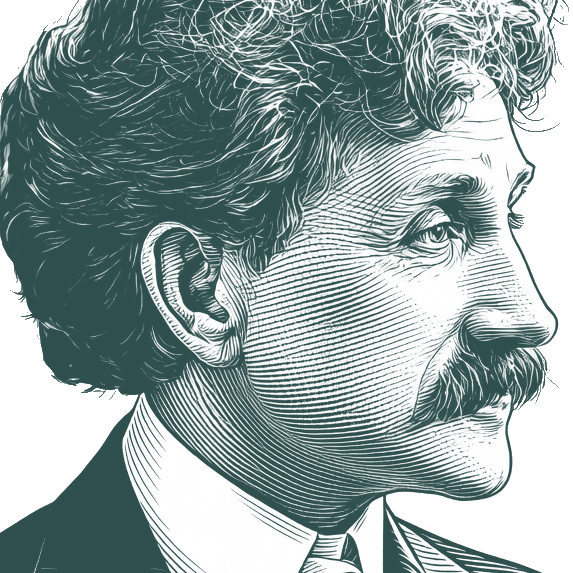
John Howard Moore (December 4, 1862 – June 17, 1916) was an American zoologist, philosopher, educator and social reformer. He advocated for the ethical consideration and treatment of animals and authored several articles, books, essays and pamphlets on topics including education, ethics, evolutionary biology, humanitarianism, utilitarianism and vegetarianism. He is best known for his work The Universal Kinship (1906), which advocated for a secular sentiocentric philosophy he called the doctrine of "Universal Kinship", based on the shared evolutionary kinship between all sentient beings.
Organize your favorite quotes without limits. Create themed collections for every occasion with Premium.
Related quotes. More quotes will automatically load as you scroll down, or you can use the load more buttons.
The thesis of the New Ethics is the ethical corollary of the doctrine of evolution. It is simply the expansion of ethics to suit the biological revelations of Charles Darwin. The present ethical conception is based on the pre-Darwinian belief that all other species of animals and all worlds were produced for the exclusive benefit of the human species. It is anthropocentric. It originated among primitive peoples. It has come all the way down through the centuries, not because of its beauty or its fitness for immortality among ideas, but because of the excellent opportunities each generation has had of inoculating each succeeding generation with anything it has had a mind to.
A carnivorous animal is not an ideal animal, and never can be. The life of a carnivorous animal is a perpetual onslaught. Every meal is a murder. Eating is not the harmless activity it is to one who sits down to fruit and grains. The carnivore must kill somebody, or have somebody else do it for him, in order to eat. It cannot be otherwise. And an animal whose life is one unbroken succession of such necessities, whose stomach is the grave of hundreds and thousands, and even of tens of thousands, of his fellow-beings, may be meritorious in other respects — may preach the Golden Rule, decry war, give money to the missionary, and rail at the rich — but so long as he continues to fill himself every few hours with the blood and vitals of others, he is not only not an ideal animal, but has in reality no just claims on life. Flesh is a painful form of nutrition for any organism, but it is especially so for man, because it is unnecessary, and because man makes so many pretensions and occupies a position in the world of such exceptional responsibility.
Filter search results by source, date, and more with our premium search tools.
[M]an is an animal. It was away out there on the prairies, among the green corn rows, one beautiful June morning—a long time ago it seems to me now—that this revelation really came to me. And I repeat it here, as it has grown to seem to me, for the sake of a world which is so wise in many things, but so darkened and wayward regarding this one thing. However averse to accepting it we may be on account of favourite traditions, man is an animal in the most literal and materialistic meaning of the word. Man has not a spark of so-called 'divinity' about him. In important respects he is the most highly evolved of animals; but in origin, disposition, and form he is no more 'divine' than the dog who laps his sores, the terrapin who waddles over the earth in a carapace, or the unfastidious worm who dines on the dust of his feet. Man is not the pedestalled individual pictured by his imagination—a being glittering with prerogatives, and towering apart from and above all other beings. He is a pain-shunning, pleasure-seeking, death-dreading organism, differing in particulars, but not in kind, from the pain-shunning, pleasure-seeking, death-dreading organisms below and around him. Man is neither a rock, a vegetable, nor a deity. He belongs to the same class of existences, and has been brought into existence by the same evolutional processes, as the horse, the toad that hops in his garden, the firefly that lights its twilight torch, and the bivalve that reluctantly feeds him.