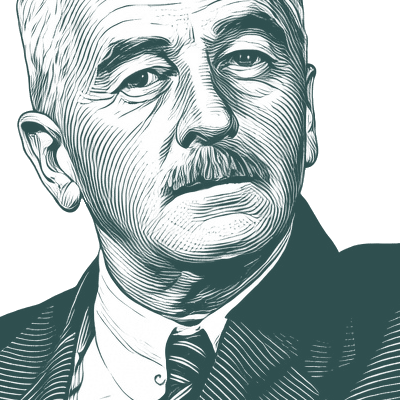
He had a word, too. Love, he called it. But I had been used to words for a long time. I knew that that word was like the others: just a shape to fill… - William Faulkner
""
He had a word, too. Love, he called it. But I had been used to words for a long time. I knew that that word was like the others: just a shape to fill a lack; that when the right time came, you wouldn’t need a word for that anymore than for pride or fear.
English
Collect this quote
About
William Faulkner
William Cuthbert Faulkner (September 25, 1897 – July 6, 1962) was an American novelist and short story writer whose works feature his native state of Mississippi. He was regarded as one of the most influential writers of the twentieth century and was awarded the 1949 Nobel Prize for Literature.
Biography information from
Wikiquote·
Portrait adapted from
Wikimedia Commons, Carl Van Vechten (Public domain / CC0)
Doomed and knew it, accepted the doom without either seeking or fleeing it. Loved her brother despite him, loved not only him but loved in him that bitter prophet and inflexible corruptless judge of what he considered the family's honor and its doom, as he thought he loved but really hated in her what he considered the frail doomed vessel of its pride and the foul instrument of its disgrace, not only this, she loved him not only in spite of but because of the fact that he himself was incapable of love, accepting the fact that he must value above all not her but the virginity of which she was custodian and on which she placed no value whatever: the frail physical stricture which to her was no more than a hangnail would have been. Knew the brother loved death best of all and was not jealous, would (and perhaps in the calculation and deliberation of her marriage did) have handed him the hypothetical hemlock. Was two months pregnant with another man's child which regardless of what its sex would be she had already named Quentin after the brother whom they both (she and her brother) knew was already the same as dead...
It was too late. Maybe yesterday, while I was still a child, but not now. I knew too much, had seen too much, I was a child no longer now; innocence and childhood were forever lost, forever gone from me.
PREMIUM FEATURE
Advanced Search Filters
Filter search results by source, date, and more with our premium search tools.
"Now I want you to tell me just one thing more. Why do you hate the South?" "I dont hate it," Quentin said, quickly, at once, immediately; "I dont hate it," he said. I dont hate it he thought, panting in the cold air, the iron New England dark: I dont. I dont! I dont hate it! I dont hate it!