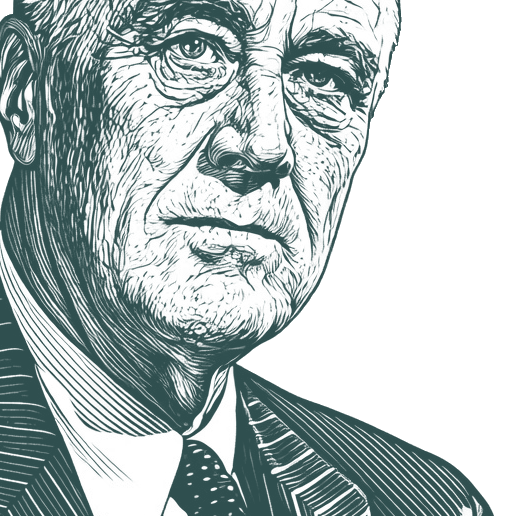
I certainly would not indicate a preference in a State primary merely because a candidate, otherwise liberal in outlook, had conscientiously differed… - Franklin Delano Roosevelt
""
I certainly would not indicate a preference in a State primary merely because a candidate, otherwise liberal in outlook, had conscientiously differed with me on any single issue. I should be far more concerned about the general attitude of a candidate toward present day problems and his own inward desire to get practical needs attended to in a practical way. We all know that progress may be blocked by outspoken reactionaries and also by those who say "yes" to a progressive objective, but who always find some reason to oppose any specific proposal to gain that objective. I call that type of candidate a "yes, but" fellow.
English
Collect this quote
About
Franklin Delano Roosevelt
Franklin Delano Roosevelt (30 January 1882 – 12 April 1945), often referred to by his initials FDR, was an American statesman and political leader who served as the president of the United States, from 1933, to 1945. A Democrat, he won a record four presidential elections and dominated his party for many years as a central figure in world events during the mid-20th century, leading the United States during a time of worldwide economic depression and total war. His program for relief, recovery and reform, known as the New Deal, involved a great expansion of the role of the federal government in the economy.
In politics, nothing happens by accident. If it happens, you can bet it was planned that way.
It is true that other Nations may, as they do, enforce contrary rules of conscience and conduct. It is true that policies may be pursued under flags other than our own, but those policies are beyond our jurisdiction. Yet in our inner individual lives we can never be indifferent, and we assert for ourselves complete freedom to embrace, to profess and to observe the principles for which our flag has so long been the lofty symbol. As it was so well said by James Madison, over a century ago: "We hold it for a fundamental and inalienable truth that religion and the manner of discharging it can be directed only by reason and conviction, not by force or violence."
PREMIUM FEATURE
Advanced Search Filters
Filter search results by source, date, and more with our premium search tools.
The destiny of America was proclaimed in words of prophecy spoken by our first President in his first inaugural in 1789 — words almost directed, it would seem, to this year of 1941: "The preservation of the sacred fire of liberty and the destiny of the republican model of government are justly considered … deeply,... finally, staked on the experiment intrusted to the hands of the American people."