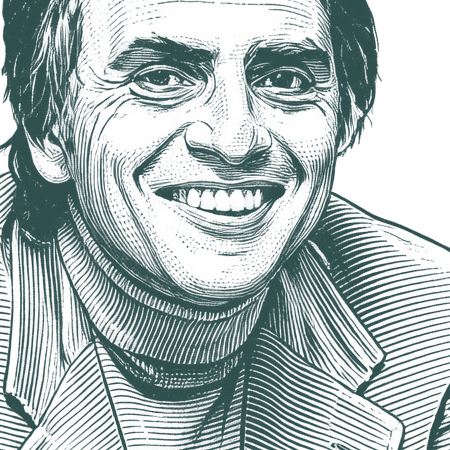
The truth may be puzzling. It may take some work to grapple with. It may be counterintuitive. It may contradict deeply held prejudices. It may not be… - Carl Sagan
""
The truth may be puzzling. It may take some work to grapple with. It may be counterintuitive. It may contradict deeply held prejudices. It may not be consonant with what we desperately want to be true. But our preferences do not determine what's true.
Carl Edward Sagan (9 November 1934 – 20 December 1996) was an American astronomer, planetary scientist, cosmologist, astrophysicist, astrobiologist, author, and science communicator. His best known scientific contribution is research on extraterrestrial life, including experimental demonstration of the production of amino acids from basic chemicals by radiation. Sagan assembled the first physical messages sent into space, the Pioneer plaque and the Voyager Golden Record, universal messages that could potentially be understood by any extraterrestrial intelligence that might find them. Sagan argued the hypothesis, accepted since, that the high surface temperatures of Venus can be attributed to, and calculated using, the greenhouse effect. He testified to the US Congress in 1985 that the greenhouse effect will change the earth's climate system.
Biography information from
Wikiquote·
Portrait adapted from
Wikimedia Commons, NASA/JPL (Public domain / CC0)
Also Known As
Native Name:
Carl Edward Sagan
Alternative Names:
Sagan
•
Carl E. Sagan
•
Carl E Sagan
•
C. E. Sagan
•
C.E. Sagan
•
C E Sagan
•
C. Sagan
•
C Sagan
•
Sagan C
•
Sagan C.
•
Sagan C. E.
•
Sagan CE
If we offer too much silent assent about mysticism and superstition - even when it seems to be doing a little good - we abet a general climate in which skepticism is considered impolite, science tiresome, and rigorous thinking somehow stuffy and inappropriate.
High above the visible cloud deck, at about 70 kilometers altitude, there is a continuous haze of small particles. At 60 kilometers, we plunge into the clouds, and find ourselves surrounded by droplets of concentrated sulfuric acid. As we go deeper, the could particles tend to get bigger. The pungent gas, sulfur dioxide, SO2, is present in trace amounts in the lower atmosphere. It is circulated up above the clouds, broken down by ultraviolet light from the Sun and recombined with water there to form sulfuric acid- which condenses into droplets, settles, and at lower altitudes is broken down by heat into SO2 and water again, completing the cycle. It is always raining sulfuric acid on Venus, all over the planet, and not a drop ever reaches the surface. p79
Works in ChatGPT, Claude, or Any AI
Add semantic quote search to your AI assistant via MCP. One command setup.
"A book is made from a tree. It is an assemblage of flat, flexible parts (still called "leaves") imprinted with dark pigmented squiggles. One glance at it and you hear the voice of another person, perhaps someone dead for thousands of years. Across the millennia, the author is speaking, clearly and silently, inside your head, directly to you. Writing is perhaps the greatest of human inventions, binding together people, citizens of distant epochs, who never knew one another. Books break the shackles of time — proof that humans can work magic."