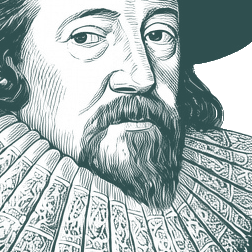
Francis Bacon, 1st Viscount St. Alban KC (22 January 1561 – 9 April 1626) was an English philosopher, statesman and essayist. His works argued for the possibility of scientific knowledge based only upon inductive reasoning and careful observation of events in nature. Most importantly, he argued this could be achieved by use of a sceptical and methodical approach whereby scientists aim to avoid misleading themselves. His general idea of the importance and possibility of a skeptical methodology makes Bacon the father of the scientific method. This marked a new turn in the rhetorical and theoretical framework for science, the practical details of which are still central in debates about science and methodology today.
Biography information from
Wikiquote·
Portrait adapted from
Wikimedia Commons, Paul van Somer I / Formerly attributed to Frans Pourbus the Younger (Public domain / CC0)
Also Known As
Alternative Names:
Franciscus Bacon
•
Francis Bacon of Verulamius
•
Francis Bacon, Lord Verulam
•
Bacon, Francis, 1561-1626
•
Francis Bacon, Viscount Saint Alban
Portrait from Wikimedia Commons. Credit: Paul van Somer I / Formerly attributed to Frans Pourbus the Younger. Used under Public domain / CC0. Processed and styled by Quotewise.
Try QuoteGPT
Chat naturally about what you need. Each answer links back to real quotes with citations.
Related quotes. More quotes will automatically load as you scroll down, or you can use the load more buttons.
Men fear death as children fear to go into the dark and as that natural fear in children is increased with tales, so is the other
We have also sound houses, where we practice and demonstrate all sounds and their generation. We have harmonies which you have not, of quarter sounds and lesser slides of sounds. Divers instruments of music likewise to you unknown, some sweeter than any you have; together with bells and rings that are dainty and sweet. We represent small sounds as great and deep; likewise divers trembling and warblings of sounds, which in their original are entire. We represent and imitate all articulate sounds and letters, and the voices of beasts and birds. We have certain helps which set to the ear to do further the hearing greatly. We have also divers strange and artificial echoes, reflecting the voice many times, and as if it were tossing it; and some that give back the voice louder than it came, some shriller and some deeper; yea, some rendering the voice, differing in the letters or articulate sound from that they receive. We have also means to convey sounds in tubes and pipes, in strange lines and distance (…).
What then remains, but that we still should cry Not to be born, or being born, to die?