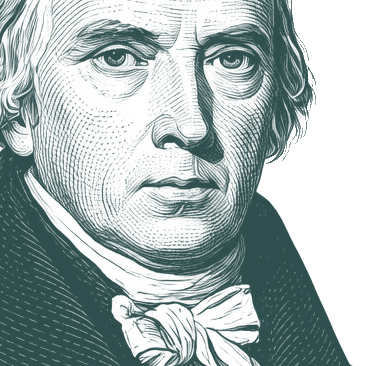
A man has a property in his opinions and the free communication of them.
He has a property of peculiar value in his religious opinions, and in the pr… - James Madison
""
A man has a property in his opinions and the free communication of them. He has a property of peculiar value in his religious opinions, and in the profession and practice dictated by them. He has a property very dear to him in the safety and liberty of his person. He has an equal property in the free use of his faculties and free choice of the objects on which to employ them. In a word, as a man is said to have a right to his property, he may be equally said to have a property in his rights.
James Madison Jr. (16 March 1751 – 28 June 1836) was an American statesman, diplomat, and Founding Father who served as the fourth president of the United States from 1809 to 1817. Madison was popularly acclaimed the "Father of the Constitution" for his pivotal role in drafting and promoting the Constitution of the United States and the Bill of Rights.
Biography information from
Wikiquote·
Portrait adapted from
Wikimedia Commons, John Vanderlyn (Public domain / CC0)
Also Known As
Birth Name:
James Madison, Jr.
Alternative Names:
James Madison Jr.
•
President Madison
•
President James Madison
The war has proved moreover that our free Government, like other free governments, though slow in its early movements, acquires in its progress a force proportioned to its freedom, and that the union of these States, the guardian of the freedom and safety of all and of each, is strengthened by every occasion that puts it to the test.
If Congress can apply money indefinitely to the general welfare, and are the sole and supreme judges of the general welfare, they may take the care of religion into their own hands; they may establish teachers in every State, county, and parish, and pay them out of the public Treasury; they may take into their own hands the education of children, establishing in like manner schools throughout the Union; they may undertake the regulation of all roads other than post roads. In short, every thing, from the highest object of State legislation, down to the most minute object of police, would be thrown under the power of Congress; for every object I have mentioned would admit the application of money, and might be called, if Congress pleased, provisions for the general welfare.
PREMIUM FEATURE
Advanced Search Filters
Filter search results by source, date, and more with our premium search tools.