In contemporary Western society, buying a magazine on astrology - at a newsstand, say - is easy; it is much harder to find one on astronomy. Virtuall… - Carl Sagan
""
In contemporary Western society, buying a magazine on astrology - at a newsstand, say - is easy; it is much harder to find one on astronomy. Virtually every newspaper in America has a daily column on astrology; there are hardly any that have even a weekly column on astronomy. There are ten times more astrologers in the United States than astronomers. At parties, when I meet people that do not know I’m a scientist, I am sometimes asked “Are you a Gemini?” (chances of success, one in twelve), or “What sign are you?” Much more rarely am I asked “Have you heard that gold is made in supernova explosions?” or “When do you think Congress will approve a Mars Rover?” (...) And personal astrology is with us still: consider two different newspaper astrology columns published in the same city on the same day. For example, we can examine The New York Post and the New York Daily News on September 21, 1979. Suppose you are a Libra - that is, born between September 23 and October 22. According to the astrologer for the Post, ‘a compromise will help ease tension’; useful, perhaps, but somewhat vague. According to the Daily News’ astrologer, you must ‘demand more of yourself’, an admonition that is also vague but also different. These ‘predictions’ are not predictions; rather they are pieces of advice - they tell you what to do, not what will happen. Deliberately, they are phrased so generally that they could apply to anyone. And they display major mutual inconsistencies. Why are they published as unapologetically as sport statistics and stock market reports? Astrology can be tested by the lives of twins. There are many cases in which one twin is killed in childhood, in a riding accident, say, or is struck by lightning, while the other lives to a prosperous old age. Each was born in precisely the same place and within minutes of the other. Exactly the same planets were rising at their births. If astrology were valid, how could two such twins have such profoundly different fates? It a
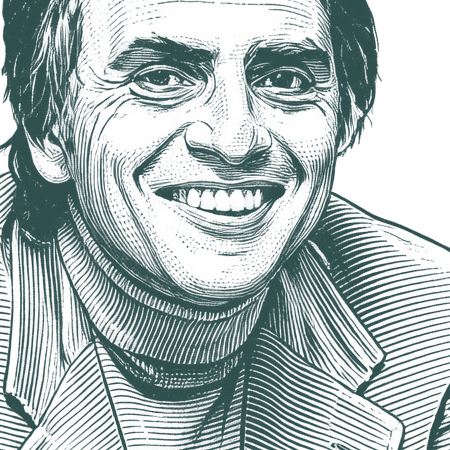
Carl Edward Sagan (9 November 1934 – 20 December 1996) was an American astronomer, planetary scientist, cosmologist, astrophysicist, astrobiologist, author, and science communicator. His best known scientific contribution is research on extraterrestrial life, including experimental demonstration of the production of amino acids from basic chemicals by radiation. Sagan assembled the first physical messages sent into space, the Pioneer plaque and the Voyager Golden Record, universal messages that could potentially be understood by any extraterrestrial intelligence that might find them. Sagan argued the hypothesis, accepted since, that the high surface temperatures of Venus can be attributed to, and calculated using, the greenhouse effect. He testified to the US Congress in 1985 that the greenhouse effect will change the earth's climate system.
Biography information from
Wikiquote·
Portrait adapted from
Wikimedia Commons, NASA/JPL (Public domain / CC0)
Also Known As
Native Name:
Carl Edward Sagan
Alternative Names:
Sagan
•
Carl E. Sagan
•
Carl E Sagan
•
C. E. Sagan
•
C.E. Sagan
•
C E Sagan
•
C. Sagan
•
C Sagan
•
Sagan C
•
Sagan C.
•
Sagan C. E.
•
Sagan CE
Every now and then, I’m lucky enough to teach a kindergarten or first-grade class. Many of these children are natural-born scientists - although heavy on the wonder side and light on scepticism. They’re curious, intellectually vigorous. Provocative and insightful questions bubble out of them. They exhibit enormous enthusiasm. I’m asked follow-up questions. They’ve never heard of the notion of a ‘dumb question’. But when I talk to high school seniors, I find something different. They memorize ‘facts’. By and large, though, the joy of discovery, the life behind those facts, has gone out of them. They’ve lost much of the wonder, and gained very little scepticism. They’re worried about asking ‘dumb’ questions; they’re willing to accept inadequate answers; they don’t pose follow-up questions; the room is awash with sidelong glances to judge, second-by-second, the approval of their peers.
From this distant vantage point, the meat planet might not seem of any particular interest: an obscure and solitary lump, suspended in a sunbeam.
If we crave some cosmic purpose, then let us find ourselves a worthy goal.