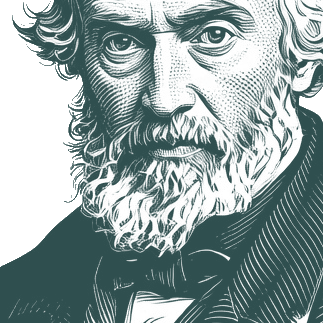
Thomas Carlyle (December 4 1795 – February 5 1881) was a Scottish essayist, historian and philosopher of great prominence during the Victorian era. His wife was Jane Welsh Carlyle.
Biography information from
Wikiquote·
Portrait adapted from
Wikimedia Commons, Sir John Everett Millais, 1st Bt (died 1896) (Public domain / CC0)
Portrait from Wikimedia Commons. Credit: Sir John Everett Millais, 1st Bt (died 1896). Used under Public domain / CC0. Processed and styled by Quotewise.
Works in ChatGPT, Claude, or Any AI
Add semantic quote search to your AI assistant via MCP. One command setup.
It is a greatness not of mere body and gigantic bulk, but a rude greatness of soul. There is a sublime uncomplaining melancholy traceable in these old hearts. A great free glance into the very deeps of thought. They seem to have seen, these brave old Northmen, what Meditation has taught all men in all ages, That this world is after all but a show,—a phenomenon or appearance, no real thing. All deep souls see into that,—the Hindoo Mythologist, the German Philosopher,—the Shakspeare, the earnest Thinker, wherever he may be.
Bright, heroic, tender, true and noble was that lost treasure of my heart, who faithfully accompanied me in all the rocky ways and climbings; and I am forever poor without her.
Go Premium
Support Quotewise while enjoying an ad-free experience and premium features.
In several respects, I consider my father as one of the most interesting men I have known. He was a man of perhaps the very largest natural endowment of any it has been my lot to converse with. None of us will ever forget that bold glowing style of his, flowing free from his untutored soul, full of metaphors (though he knew not what a metaphor was) with, all manner of potent words which he appropriated and applied with a surprising accuracy you often would not guess whence; brief, energetic, and which I should say conveyed the most perfect picture — definite, clear, not in ambitious colors, but in full white sunliglit — of all the dialects I have ever listened to. Nothing did I ever hear him undertake to render visible which, did not become almost ocularly so. Never shall we again hear such speech as that was. The whole district knew of it and laughed joyfully over it, not knowing how other-wise to express the feeling it gave them; emphatic I have heard him beyond all men. In anger he had no need of oaths, his words were like sharp arrows that smote into the very heart. The fault was that he exaggerated (which tendency I also inherit), yet only in description and for the sake chiefly of humorous effect.