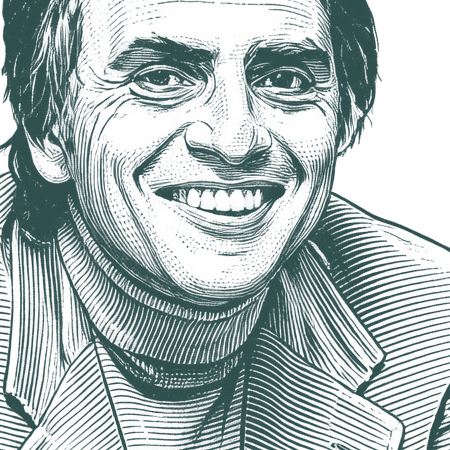
Carl Edward Sagan (9 November 1934 – 20 December 1996) was an American astronomer, planetary scientist, cosmologist, astrophysicist, astrobiologist, author, and science communicator. His best known scientific contribution is research on extraterrestrial life, including experimental demonstration of the production of amino acids from basic chemicals by radiation. Sagan assembled the first physical messages sent into space, the Pioneer plaque and the Voyager Golden Record, universal messages that could potentially be understood by any extraterrestrial intelligence that might find them. Sagan argued the hypothesis, accepted since, that the high surface temperatures of Venus can be attributed to, and calculated using, the greenhouse effect. He testified to the US Congress in 1985 that the greenhouse effect will change the earth's climate system.
Biography information from
Wikiquote·
Portrait adapted from
Wikimedia Commons, NASA/JPL (Public domain / CC0)
Also Known As
Native Name:
Carl Edward Sagan
Alternative Names:
Sagan
•
Carl E. Sagan
•
Carl E Sagan
•
C. E. Sagan
•
C.E. Sagan
•
C E Sagan
•
C. Sagan
•
C Sagan
•
Sagan C
•
Sagan C.
•
Sagan C. E.
•
Sagan CE
Our perceptions are fallible. We sometimes see what isn't there. We are prey to optical illusions. Occasionally we hallucinate. We are error-prone.
In the littered field of discredited self-congratulatory chauvinisms, there is only one that seems to hold up, one sense in which we are special: Due to our own actions or inactions, and the misuse of our technology, we live at an extraordinary moment, for the Earth at least — the first time that a species has become able to wipe itself out.
Experiences which are out of line with the teachings of Scripture must always be renounced as fallacious. The Bible has a monopoly on the truth.