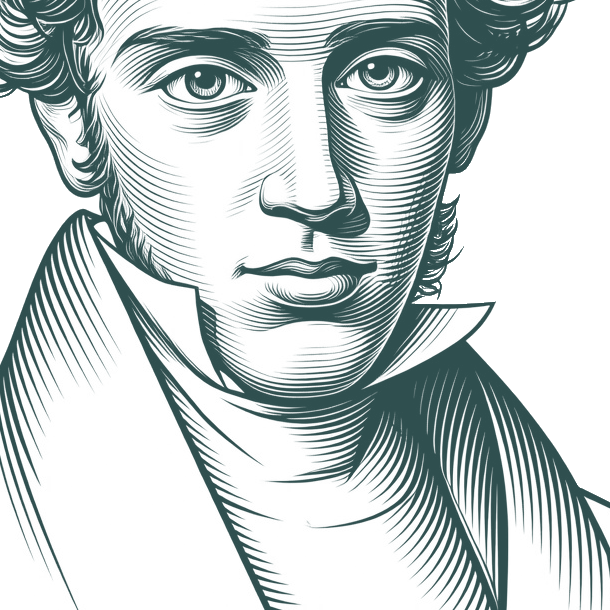
A man who but rarely, and then only cursorily, concerns himself with his relationship to God, hardly thinks or dreams that he has so closely to do wi… - Søren Kierkegaard
""
A man who but rarely, and then only cursorily, concerns himself with his relationship to God, hardly thinks or dreams that he has so closely to do with God, or that God is so close to him, that there exists a reciprocal relationship between him and God, the stronger a man is, the weaker God is, the weaker a man is, the stronger God is in him. Every one who assumes that a God exists naturally thinks of Him as the strongest, as He eternally is, being the Almighty who creates out of nothing, and for whom all the creation is as nothing; but such a man hardly thinks of the possibility of a reciprocal relationship. And yet for God, the infinitely strongest, there is an obstacle; He has posited it Himself, yea, He has lovingly, with incomprehensible love posited it Himself; for He posited it and posits it every time a man comes into existence, when He in His love makes to be something directly in apposition to Himself. Oh, marvelous omnipotence of love! A man cannot bear that his ‘creations’ should be directly in apposition to Himself, and so he speaks of them in a tone of disparagement as his ‘creations’. But God who creates out of nothing, who almightily takes from nothing and says, ‘Be’, lovingly adjoins, ‘Be something even in apposition to me.’ Marvellous love, even His omnipotence is under the sway of love!
English
Collect this quote
About
Søren Kierkegaard
Søren Aabye Kierkegaard (5 May 1813 – 11 November 1855) was a Danish Christian philosopher and theologian, considered to be a founder of Existentialist thought and Absurdist traditions. He wrote critical texts on organized religion, Christendom, morality, ethics, psychology and philosophy of religion, displaying a fondness for metaphor, irony and parables.
Biography information from
Wikiquote·
Portrait adapted from
Wikimedia Commons, La Biblioteca Real de Dinamarca (Public domain / CC0)
Also Known As
Pen Names:
Victor Eremita
•
A
•
Judge William
•
Johannes de silentio
•
Constantine Constantius
•
Young Man
•
Vigilius Haufniensis
•
Nicolaus Notabene
•
Hilarius Bookbinder
•
Johannes Climacus
•
Inter et Inter
•
H.H.
•
Anti-Climacus
•
B
•
Johannes de Silentio
•
Constantin Constantius
•
P. CH. Kierkegaard
Native Name:
Søren Aabye Kierkegaard
Alternative Names:
Kierkegaard
•
Climacus
•
Sören Aaby Kierkegaard
How empty life is and without meaning. - We bury a man, we follow him to the grave, we throw three spades of earth on him, we ride out in a coach, we ride home in a coach, we take comfort in the thought that a long life awaits us. But how long is threescore years and ten? Why not finish it at once?
The bird keeps silent and suffers. However much heartache it has, it keeps silent. It does not complain; it accuses no one; it sighs only to fall silent again. The bird is not free from suffering, but the silent bird frees itself from what makes the suffering more burdensome: from the misunderstood sympathy of others; frees itself from what makes the suffering last longer: from all the talk of suffering; frees itself from what makes the suffering into something worse than suffering: from the sin of impatience and sadness.
Works in ChatGPT, Claude, or Any AI
Add semantic quote search to your AI assistant via MCP. One command setup.
But this I thought was the meaning of life, that the individual shook off the habit of accepting the favors of difference, should that be tempting, steeled himself against its humiliation, should that weigh down on him, in order to find the universal, what is common to all human beings, to concern oneself only with that. Oh! How beautiful to lose oneself in this way. But then I thought again that in the having of this concern the meaning of life was to be concerned for oneself as if the particular individual were all there was. Oh! How beautiful thus to find oneself in the universal! If the universal is the rule then the individual is the paradigm [corrected from demand]; if the universal is the demand then the universal is the fulfillment; if the universal is everything, if the universal says everything, then the particular individual believes that the everything is said about him-him alone. So if the place and context here did not require signature, none would be needed, for again it is infinitely inconsequential who has said it (as though the favored one said it, the one who was wronged being in no position to say it, since after all they all have it in them to do it).