We are to remember what an umpire Nature is; what a greatness, composure of depth and tolerance there is in her. You take wheat to cast into the Eart… - Thomas Carlyle
""
We are to remember what an umpire Nature is; what a greatness, composure of depth and tolerance there is in her. You take wheat to cast into the Earth's bosom; your wheat may be mixed with chaff, chopped straw, barn-sweepings, dust and all imaginable rubbish; no matter: you cast it into the kind just Earth; she grows the wheat, — the whole rubbish she silently absorbs, shrouds it in, says nothing of the rubbish. The yellow wheat is growing there; the good Earth is silent about all the rest, — has silently turned all the rest to some benefit too, and makes no complaint about it! So everywhere in Nature! She is true and not a lie; and yet so great, and just, and motherly in her truth. She requires of a thing only that it be genuine of heart; she will protect it if so; will not, if not so. There is a soul of truth in all the things she ever gave harbor to. Alas, is not this the history of all highest Truth that comes or ever came into the world?
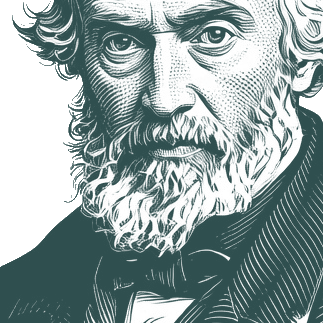
Thomas Carlyle (December 4 1795 – February 5 1881) was a Scottish essayist, historian and philosopher of great prominence during the Victorian era. His wife was Jane Welsh Carlyle.
Biography information from
Wikiquote·
Portrait adapted from
Wikimedia Commons, Sir John Everett Millais, 1st Bt (died 1896) (Public domain / CC0)
But figure his thought, when Death is now clutching at his own heart-strings, unlooked for, inexorable! Yes, poor Louis, Death has found thee. No palace walls or life-guards, gorgeous tapestries or gilt buckram of stiffest ceremonial could keep him out; but he is here, here at thy very life-breath, and will extinguish it. Thou, whose whole existence hitherto was a chimera and scenic show, at length becomest a reality: sumptuous Versailles bursts asunder, like a dream, into void Immensity; Time is done, and all the scaffolding of Time falls wrecked with hideous clangour round thy soul: the pale Kingdoms yawn open; there must thou enter, naked, all unking'd, and await what is appointed thee! Unhappy man, there as thou turnest, in dull agony, on thy bed of weariness, what a thought is thine! Purgatory and Hell-fire, now all-too possible, in the prospect; in the retrospect, — alas, what thing didst thou do that were not better undone; what mortal didst thou generously help; what sorrow hadst thou mercy on? Do the 'five hundred thousand' ghosts, who sank shamefully on so many battle-fields from Rossbach to Quebec, that thy Harlot might take revenge for an epigram, — crowd round thee in this hour? Thy foul Harem; the curses of mothers, the tears and infamy of daughters? Miserable man! thou 'hast done evil as thou couldst:' thy whole existence seems one hideous abortion and mistake of Nature; the use and meaning of thee not yet known. Wert thou a fabulous Griffin, devouring the works of men; daily dragging virgins to thy cave; — clad also in scales that no spear would pierce: no spear but Death's? A Griffin not fabulous but real! Frightful, O Louis, seem these moments for thee. — We will pry no further into the horrors of a sinner's death-bed.
Democracy, which means despair of finding any Heroes to govern you, and contented putting up with the want of them,—alas, thou too, mein Lieber, seest well how close it is of kin to Atheism, and other sad Isms: he who discovers no God whatever, how shall he discover Heroes, the visible Temples of God?
Of all the Nations in the world at present we English are the stupidest in speech, the wisest in action. As good as a 'dumb' Nation, I say, who cannot speak, and have never yet spoken,— spite of the Shakspeares and Miltons who skew us what possibilities there are!—O Mr. Bull, I look in that surly face of thine with a mixture of pity and laughter, yet also with wonder and veneration. Thou complainest not, my illustrious friend; and yet I believe the heart of thee is full of sorrow, of unspoken sadness, seriousness,—profound melancholy (as some have said) the basis of thy being. Unconsciously, for thou speakest of nothing, this great Universe is great to thee. Not by levity of floating, but by stubborn force of swimming, shalt thou make thy way. The Fates sing of thee that thou shalt many times be thought an ass and a dull ox, and shalt with a god-like indifference believe it. My friend,—and it is all untrue, nothing ever falser in point of fact! Thou art of those great ones whose greatness the small passer-by does not discern. Thy very stupidity is wiser than their wisdom. A grand vis inertiae is in thee; how many grand qualities unknown to small men! Nature alone knows thee, acknowledges the bulk and strength of thee: thy Epic, unsung in words, is written in huge characters on the face of this Planet,—sea-moles, cotton-trades, railways, fleets and cities, Indian Empires, Americas, New- Hollands; legible throughout the Solar System!