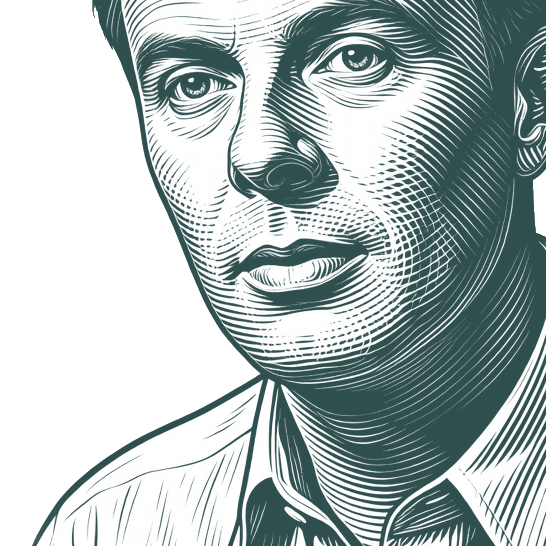
The difference between the mortified but still proud and self-centred stoic and the unmortified hedonist consists in this : the latter, being flabby,… - Aldous Huxley
""
The difference between the mortified but still proud and self-centred stoic and the unmortified hedonist consists in this : the latter, being flabby, shiftless and at heart rather ashamed of himself, lacks the energy and the motive to do much harm except to his own body, mind and spirit; the former, because he has all the secondary virtues and looks down on those who are not like himself, is morally equipped to wish and to be able to do harm on the very largest scale and with a perfectly untroubled conscience.
Aldous Leonard Huxley (26 July 1894 – 22 November 1963) was a British author known for his novel Brave New World. He was the grandson of Thomas Henry Huxley and younger brother of Julian Huxley.
That chair -shall I ever forget it? Where the shadows fell on the canvas upholstery, stripes of a deep but glowing indigo alternated with stripes of an incandescence so intensely bright that it was hard to believe that they could be made of anything but blue fire. For what seemed an immensely long time I gazed without knowing, even without wishing to know, what it was that confronted me. At any other time I would have seen a chair barred with alternate light and shade. Today the percept had swallowed up the concept. I was so completely absorbed in looking, so thunderstruck by what I actually saw, that I could not be aware of anything else. Garden furniture, laths, sunlight, shadow - these were no more than names and notions, mere verbalizations, for utilitarian or scientific purposes, after the event. The event was this succession of azure furnace doors separated by gulfs of unfathomable gentian. It was inexpressibly wonderful, wonderful to the point, almost, of being terrifying.
Still, hell or no hell, it was satisfactory, it was even exciting in those early days to know that one was doing something bad and wrong. But there is in debauchery something so intrinsically dull, something so absolutely and hopelessly dismal, that it is only the rarest beings, gifted with much less than the usual amount of intelligence and much more than the usual intensity of appetite, who can go on actively enjoying a regular course of vice or continue actively to believe in its wickedness. Most habitual debauchees are debauchees not because they enjoy debauchery, but because they are uncomfortable when deprived of it. Habit converts luxurious enjoyments into dull and daily necessities. The man who has formed a habit of women or gin, of opium-smoking or flagellation, finds it as difficult to live without his vice as to live without bread and water, even though the actual practice of the vice may have become in itself as unexciting as eating a crust or drinking a glass from the kitchen tap. Habit is as fatal to a sense of wrong-doing as to active enjoyment. After a few years the converted or sceptical Jew, the Westernized Hindu, can eat their pork and beef with an equanimity which to their still-believing brothers seems brutally cynical. It is the same with the habitual debauchee. Actions which at first seemed thrilling in their intrinsic wickedness become after a certain number of repetitions morally neutral. A little disgusting, perhaps; for the practice of most vices is followed by depressing physiological reactions; but no longer wicked, because so ordinary. It is difficult for a routine to seem wicked.
PREMIUM FEATURE
Advanced Search Filters
Filter search results by source, date, and more with our premium search tools.
By those who get a kick out of this sort of thing (and they are very numerous) inhumanity is enjoyed for its own sake, but often, nonetheless, with a bad conscience. To allay their sense of guilt, the bullies and the sadists provide themselves with a creditable excuses for their favorite sport. Thus, brutality toward children is rationalized as discipline, as obedience to the Word of God - "he that spareth the rod, hateth his son". Brutality toward criminals is a corollary of the Categorical Imperative. Brutality toward religious or political heretics is a blow for the True Faith. Brutality toward members of an alien race is justified by arguments drawn from what may once have passed for Science. Once universal, brutality toward the insane is not yet extinct - the mad are horribly exasperating. But this brutality is no longer rationalized, as it was in the past, in theological terms. The people who tormented Surin and the other victims of hysteria or psychosis did so, first, because they enjoyed being brutal and, second, because they were convinced that they did well to be brutal. And they believed that they did well, because, ex hypthesi, the mad had always brought their own troubles upon themselves. For some manifest or obscure sin, they were being punished by God, who permitted devils to besiege or obsess them. Both as God's enemies and as temporary incarnations of radical evil, they deserved the be maltreated. And maltreated they were - with a a good conscience and a heart-warming sense that the divine will was being done on earth, as in heaven.