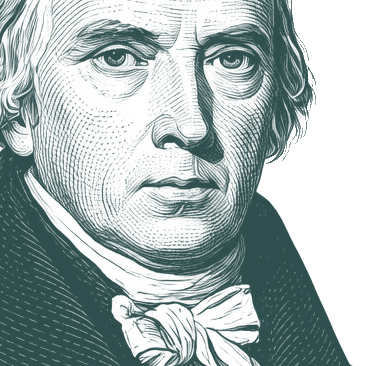
But it is understood that the nullifying doctrine imports that the decision of the State is to be presumed valid, and that it overrules the law of th… - James Madison
""
But it is understood that the nullifying doctrine imports that the decision of the State is to be presumed valid, and that it overrules the law of the United States, unless overruled by three fourths of the States.Can more be necessary to demonstrate the inadmissibility of such a doctrine, than that it puts it in the power of the smallest fraction over one fourth of the United States, that is, of seven states out of twenty four, to give the law, and even the Constitution to seventeen States; each of the seventeen having as parties to the Constitution, an equal right with each of the seven, to expound it, and to insist on the exposition. That the seven might, in particular instances be right, and the seventeen wrong, is more than possible. But to establish a positive and permanent rule giving such a power, to such a minority, over such a majority, would overturn the first principle of free government, and in practice necessarily overturn the government itself.It is to be recollected that the Constitution was proposed to the people of the States as a whole, and unanimously adopted by the States as a whole, it being a part of the Constitution that not less than three fourths of the States should be competent to make any alteration in what had been unanimously agreed to.
James Madison Jr. (16 March 1751 – 28 June 1836) was an American statesman, diplomat, and Founding Father who served as the fourth president of the United States from 1809 to 1817. Madison was popularly acclaimed the "Father of the Constitution" for his pivotal role in drafting and promoting the Constitution of the United States and the Bill of Rights.
Biography information from
Wikiquote·
Portrait adapted from
Wikimedia Commons, John Vanderlyn (Public domain / CC0)
Also Known As
Birth Name:
James Madison, Jr.
Alternative Names:
James Madison Jr.
•
President Madison
•
President James Madison
Religious bondage shackles and debilitates the mind and unfits it for every noble enterprise.... During almost fifteen centuries has the legal establishment of Christianity been on trial. What have been its fruits? More or less, in all places, pride and indolence in the clergy; ignorance and servility in laity; in both, superstition, bigotry, and persecution.
But what is government itself but the greatest of all reflections on human nature.
Unlimited Quote Collections
Organize your favorite quotes without limits. Create themed collections for every occasion with Premium.
The danger of silent accumulations & encroachments by Ecclesiastical Bodies have not sufficiently engaged attention in the U. S. [...] But besides the danger of a direct mixture of Religion & civil Government, there is an evil which ought to be guarded agst in the indefinite accumulation of property from the capacity of holding it in perpetuity by ecclesiastical corporations. The power of all corporations, ought to be limited in this respect. The growing wealth acquired by them never fails to be a source of abuses. A warning on this subject is emphatically given in the example of the various Charitable establishments in G. B. the management of which has been lately scrutinized. The excessive wealth of ecclesiastical Corporations and the misuse of it in many Countries of Europe has long been a topic of complaint. In some of them the Church has amassed half perhaps the property of the nation. When the reformation took place, an event promoted if not caused, by that disordered state of things, how enormous were the treasures of religious societies, and how gross the corruptions engendered by them; so enormous & so gross as to produce in the Cabinets & Councils of the Protestant states a disregard, of all the pleas of the interested party drawn from the sanctions of the law, and the sacredness of property held in religious trust. The history of England during the period of the reformation offers a sufficient illustration for the present purpose. [...] Are there not already examples in the U. S. of ecclesiastical wealth equally beyond its object and the foresight of those who laid the foundation of it? In the U. S. there is a double motive for fixing limits in this case, because wealth may increase not only from additional gifts, but from exorbitant advances in the value of the primitive one. In grants of vacant lands, and of lands in the vicinity of growing towns & Cities the increase of value is often such as if foreseen, would essentially controul the liberality confirming them. The people of the U. S. owe their Independence & their liberty, to the wisdom of descrying in the minute tax of 3 pence on tea, the magnitude of the evil comprized in the precedent. Let them exert the same wisdom, in watching agst every evil lurking under plausible disguises, and growing up from small beginnings. Obsta principiis.