Sirs, I am but a nameless man,
A rhymester without a home,
Yet since I come of the Wessex clay
And carry the cross of Rome,
I will even answer the m… - G. K. Chesterton
""
Sirs, I am but a nameless man, A rhymester without a home, Yet since I come of the Wessex clay And carry the cross of Rome,
I will even answer the mighty earl That asked of Wessex men Why they be meek and monkish folk, And bow to the White Lord's broken yoke; What sign have we save blood and smoke? Here is my answer then.
That on you is fallen the shadow, And not upon the Name; That though we scatter and though we fly, And you hang over us like the sky, You are more tired of victory, Than we are tired of shame.
That though you hunt the Christian man Like a hare on the hill-side, The hare has still more heart to run Than you have heart to ride.
That though all lances split on you, All swords be heaved in vain, We have more lust again to lose Than you to win again.
Your lord sits high in the saddle, A broken-hearted king, But our king Alfred, lost from fame, Fallen among foes or bonds of shame, In I know not what mean trade or name, Has still some song to sing.
Our monks go robed in rain and snow, But the heart of flame therein, But you go clothed in feasts and flames, When all is ice within;
Nor shall all iron dooms make dumb Men wandering ceaselessly, If it be not better to fast for joy Than feast for misery.
Nor monkish order only Slides down, as field to fen, All things achieved and chosen pass, As the White Horse fades in the grass, No work of Christian men.
Ere the sad gods that made your gods Saw their sad sunrise pass, The White Horse of the White Horse Vale, That you have left to darken and fail, Was cut out of the grass.
Therefore your end is on you, Is on you and your kings, Not for a fire in Ely fen, Not that your gods are nine or ten, But because it is only Christian men Guard even heathen things.
For our God hath blessed creation, Calling it good. I know What spirit with whom you blindly band Hath blessed destruction with his hand; Yet by God's death the stars shall stand And the small apples grow.
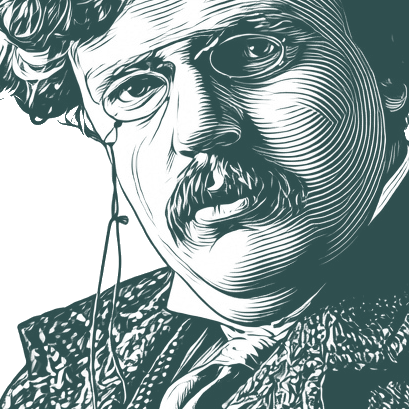
Gilbert Keith Chesterton (29 May 1874 – 14 June 1936) was a British writer whose prolific and diverse output included works of philosophy, ontology, poetry, play writing, journalism, public lecturing and debating, literary and art criticism, biography, Christian apologetics (particularly for Catholicism), and fiction, including fantasy and detective fiction. He has been called the "prince of paradox".
Biography information from
Wikiquote·
Portrait adapted from
Wikimedia Commons, Ernest Herbert Mills (Public domain / CC0)
Also Known As
Native Name:
Gilbert Keith Chesterton
Alternative Names:
František Kafka
•
Kafka
•
Gilbert K. Chesterton
•
Gilbert Chesterton
•
G.K. Chesterton
•
G. K. C.
The human race, to which so many of my readers belong, has been playing at children's games from the beginning, and will probably do it till the end, which is a nuisance for the few people who grow up. And one of the games to which it is most attached is called “Keep to-morrow dark,” and which is also named (by the rustics in Shropshire, I have no doubt) “Cheat the Prophet.” The players listen very carefully and respectfully to all that the clever men have to say about what is to happen in the next generation. The players then wait until all the clever men are dead, and bury them nicely. They then go and do something else. That is all. For a race of simple tastes, however, it is great fun. For human beings, being children, have the childish wilfulness and the childish secrecy. And they never have from the beginning of the world done what the wise men have seen to be inevitable.