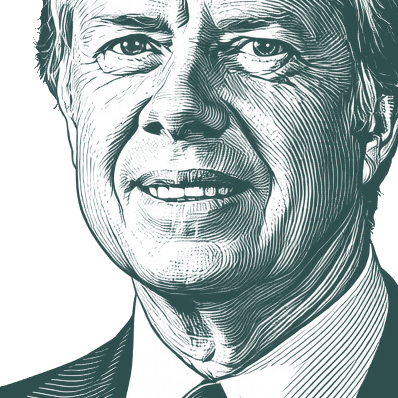
Among my first proposals as President was one to stimulate the overall economy and especially to provide jobs for teenagers in the inner cities. We'v… - Jimmy Carter
""
Among my first proposals as President was one to stimulate the overall economy and especially to provide jobs for teenagers in the inner cities. We've now established a program to provide 1.1 million jobs, summer jobs, for youth more than ever in history. We proposed, in addition, a youth employment program with 1.5 million jobs for unemployed youth. We've doubled the size of the Peace Corps, the Job Corps, and we've more than doubled the public service jobs for the unemployed--from 310,000 to 725,000, nearly half of these for the long-term unemployed. Soon, before August 5, we'll be sending to the Congress our proposal for basic welfare reform. Jobs will be the thrust behind this reform program for those who are able to work and self-respect and adequate living conditions for those who are not able to work. Our goal is for all those who want to work to be able to find work so that they can be independent and so they can be proud and they can be self-sufficient. And I'd like to point out that an emphasis on jobs and work for those who are able is not discriminatory, it's not moving backwards, and it's not a deprivation of basic rights. What we want is for people who are able not to be permanently dependent on government, but able to stand on their own feet, support their own family, and have a constructive attitude toward our society. In this welfare proposal, there will be an additional 1 million job opportunities. Our goal is to make sure that every single family has a member of it with a guaranteed job, by government if necessary, and this is a goal that we intend to reach.
English
Collect this quote
About
Jimmy Carter
James Earl Carter, Jr. (October 1, 1924 – December 29, 2024) was an American politician and member of the Democratic Party who served as the 39th president of the United States from 1977 to 1981. In 1982 he established the Carter Center, as a base for promoting human rights, democracy, finding peaceful solutions to international conflicts, and advancing economic and social development, for which he was awarded the Nobel Peace Prize in 2002. He was a key figure in the Habitat for Humanity project, and has been noted for his criticism of Israel's role in the Israeli–Palestinian conflict.
Biography information from
Wikiquote·
Portrait adapted from
Wikimedia Commons, Department of Defense. Department of the Navy. Naval Photographic Center (Public domain / CC0)
Also Known As
Birth Name:
James Earl Carter Jr.
Alternative Names:
James E. Carter
•
James Carter
•
James Earl Carter
•
39th President of the United States
•
James E. Carter Jr.
•
James Earl Carter, Jr.
•
James E. Carter, Jr.
The most serious and universal problem is the growing chasm between the richest and poorest people on earth. Citizens of the ten wealthiest countries are now seventy-five times richer than those who live in the ten poorest ones, and the separation is increasing every year, not only between nations but also within them.
1977 is a year when we are seeing major legislation, long overdue, passed, hopefully, that cause some increases in taxes. And additional taxes are necessary to restore the integrity of the social security system; some wellhead taxes are necessary to carry out a comprehensive energy policy and to hold down unnecessary consumption. I would hope that all those changes in the law that bring about any tax increase would be concluded in 1977. In 1978, there will be substantial tax reductions, and combined with that will be an adequate proposal for tax reform. I spent several hours this week going over the details of our tax reform package. We can't conclude that analysis until we know what will be done on energy and social security, because they have such a high impact on the tax structure. But there will be substantial tax reductions in 1978, combined with comprehensive tax reform.
A visiting pastor at our church in Plains once told a story about a priest from New Orleans. Father Flanagan’s parish lay in the central part of the city, close to many taverns. One night he was walking down the street and saw a drunk thrown out of a pub. The man landed in the gutter, and Father Flanagan quickly recognized him as one of his parishioners, a fellow named Mike. Father Flanagan shook the dazed man and said, “Mike!” Mike opened his eyes and Father Flanagan said, “You’re in trouble. If there is anything I can do for you, please tell me what it is.ℍ “Well, Father,” Mike replied, “I hope you’ll pray for me.” “Yes,” the priest answered, “I’ll pray for you right now.” He knelt down in the gutter and prayed, “Father, please have mercy on this drunken man.ℍ At this, a startled Mike woke up fully and said, “Father, please don’t tell God I’m drunk.ℍ Sometimes we don’t feel much of a personal relationship between God and ourselves, as though we have a secret life full of failures and sins that God knows nothing about. We want to involve God only when we plan to give thanks or when we’re in trouble and need help. But the rest of our lives, we’d rather keep to ourselves.