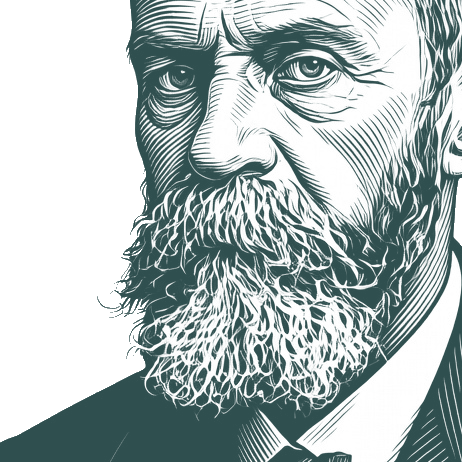
Man can never have enough without having too much. - William James
""
Man can never have enough without having too much.
English
Collect this quote
About
William James
William James (11 January 1842 – 26 August 1910) was a pioneering American psychologist and philosopher. He developed the philosophical perspective known as radical empiricism, and wrote influential books on the science of psychology, the psychology of religious experience and mysticism, and the philosophy of pragmatism.
Biography information from
Wikiquote·
Portrait adapted from
Wikimedia Commons, Alice Boughton (Public domain / CC0)
All the higher, more penetrating ideals are revolutionary. They present themselves far less in the guise of effects of past experience than in that of probable causes of future experience.
Man's chief difference from the brutes lies in the exuberant excess of his subjective propensities — his preeminence over them simply and solely in the number and in the fantastic and unnecessary character of his wants, physical, moral, aesthetic, and intellectual. Had his whole life not been a quest for the superfluous, he would never have established himself as inexpugnably as he has done in the necessary.
Unlimited Quote Collections
Organize your favorite quotes without limits. Create themed collections for every occasion with Premium.
Common-Law judges sometimes talk about the law, and schoolmasters talk about the latin tongue, in a way to make their hearers think they mean entities pre-existent to the decisions or the words and syntax, determining them unequivocally and requiring them to obey. But the slightest exercise of reflection makes us see that, instead of being principles of this kind, both law and latin are results. [...] Truth grafts itself on previous truth, modifying it in the process, just as idiom grafts itself on previous idiom, and law on previous law.