Natural historians tend to avoid tendentious preaching in this philosophical mode (although I often fall victim to such temptations in these essays).… - Stephen Jay Gould
""
Natural historians tend to avoid tendentious preaching in this philosophical mode (although I often fall victim to such temptations in these essays). Our favored style of doubting is empirical: if I wish to question your proposed generality, I will search for a counterexample in flesh and blood. Such counterexamples exist in abundance, for they form a staple in a standard genre of writing in natural history — the “wonderment of oddity” or “strange ways of the beaver” tradition.
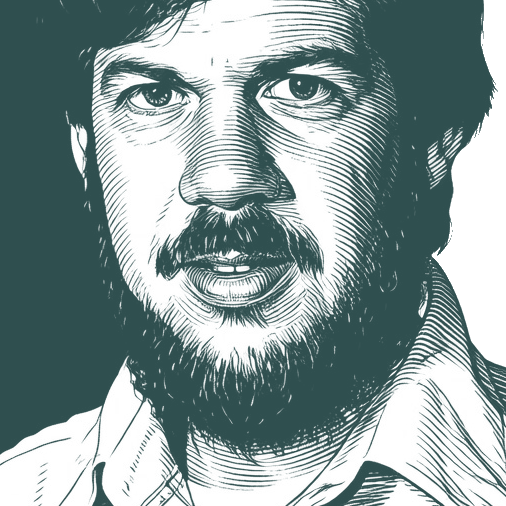
Stephen Jay Gould (September 10, 1941 – May 20, 2002) was an American geologist, paleontologist, evolutionary biologist and popular-science author, who spent most of his career teaching at Harvard University and working at the American Museum of Natural History in New York. He was one of the most influential and widely read writers of popular science of his generation.
Biography information from
Wikiquote·
Portrait adapted from
Wikimedia Commons, Lawrence Lipke (Public domain / CC0)
Environments without oxygen are excellent for the preservation of soft parts: no oxidation, no decay by aerobic bacteria. Such conditions are common on earth, particularly in stagnant basins. But the very conditions that promote preservation also decree that few organisms, if any, make their natural home in such places.
Sociobiology is not just any statement that biology, genetics, and evolutionary theory have something to do with human behavior. Sociobiology is a specific theory about the nature of genetic and evolutionary input into human behavior. It rests upon the view that natural selection is a virtually omnipotent architect, constructing organisms part by part as best solutions to problems of life in local environments. It fragments organisms into “traits,” explains their existence as a set of best solutions, and argues that each trait is a product of natural selection operating “for” the form or behavior in question. Applied to humans, it must view specific behaviors (not just general potentials) as adaptations built by natural selection and rooted in genetic determinants, for natural selection is a theory of genetic change. Thus, we are presented with unproved and unprovable speculations about the adaptive and genetic basis of specific human behaviors: why some (or all) people are aggressive, xenophobic, religious, acquisitive, or homosexual.
As arrogant as I may be in general, I am not sufficiently doltish or vainglorious to imagine that I can meaningfully address the deep philosophical questions embedded within this general inquiry of our intellectual ages — that is, fruitful modes of analysis for the history of human thought. I shall therefore take refuge in an escape route that has traditionally been granted to scientists: the liberty to act as a practical philistine. Instead of suggesting a principled and general solution, I shall ask whether I can specify an operational way to define “Darwinism” (and other intellectual entities) in a manner specific enough to win shared agreement and understanding among readers, but broad enough to avoid the doctrinal quarrels about membership and allegiance that always seem to arise when we define intellectual commitments as pledges of fealty to lists of dogmata (not to mention initiation rites, secret handshakes and membership cards — in short, the intellectual paraphernalia that led Karl Marx to make his famous comment to a French journalist: “je ne suis pas marxiste”).