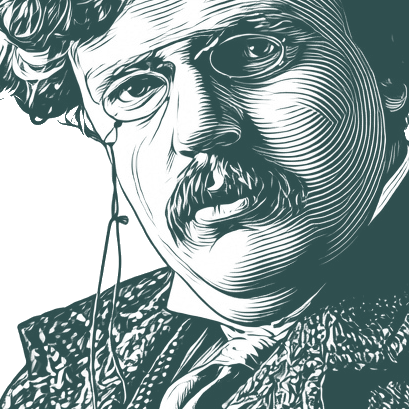
Gilbert Keith Chesterton (29 May 1874 – 14 June 1936) was a British writer whose prolific and diverse output included works of philosophy, ontology, poetry, play writing, journalism, public lecturing and debating, literary and art criticism, biography, Christian apologetics (particularly for Catholicism), and fiction, including fantasy and detective fiction. He has been called the "prince of paradox".
Biography information from
Wikiquote·
Portrait adapted from
Wikimedia Commons, Ernest Herbert Mills (Public domain / CC0)
Also Known As
Native Name:
Gilbert Keith Chesterton
Alternative Names:
František Kafka
•
Kafka
•
Gilbert K. Chesterton
•
Gilbert Chesterton
•
G.K. Chesterton
•
G. K. C.
Men that are men again: Who goes home? Tocsin and trumpeter! Who goes home? For there's blood on the grass and blood on the foam, And blood on the body, when Man comes home. And a voice valedictory: Who is for victory? Who is for liberty? Who goes home?
Fairy tales, then, are not responsible for producing in children fear, or any of the shapes of fear; fairy tales do not give the child the idea of the evil or the ugly; that is in the child already, because it is in the world already. Fairy tales do not give the child his first idea of bogey. What fairy tales give the child is his first clear idea of the possible defeat of bogey. The baby has known the dragon intimately ever since he had an imagination. What the fairy tale provides for him is a St. George to kill the dragon.
Exactly what the fairy tale does is this: it accustoms him for a series of clear pictures to the idea that these limitless terrors had a limit, that these shapeless enemies have enemies in the knights of God, that there is something in the universe more mystical than darkness, and stronger than strong fear.
Truths turn into dogmas the instant that they are disputed. Thus every man who utters a doubt defines a religion. And the scepticism of our time does not really destroy the beliefs, rather it creates them; gives them their limits and their plain and defiant shape. We who are Liberals once held Liberalism lightly as a truism. Now it has been disputed, and we hold it fiercely as a faith. We who believe in patriotism once thought patriotism to be reasonable, and thought little more about it. Now we know it to be unreasonable, and know it to be right. We who are Christians never knew the great philosophic common sense which inheres in that mystery until the anti-Christian writers pointed it out to us. The great march of mental destruction will go on. Everything will be denied. Everything will become a creed. It is a reasonable position to deny the stones in the street; it will be a religious dogma to assert them. It is a rational thesis that we are all in a dream; it will be a mystical sanity to say that we are all awake. Fires will be kindled to testify that two and two make four. Swords will be drawn to prove that leaves are green in summer. We shall be left defending, not only the incredible virtues and sanities of human life, but something more incredible still, this huge impossible universe which stares us in the face. We shall fight for visible prodigies as if they were invisible. We shall look on the impossible grass and the skies with a strange courage. We shall be of those who have seen and yet have believed.