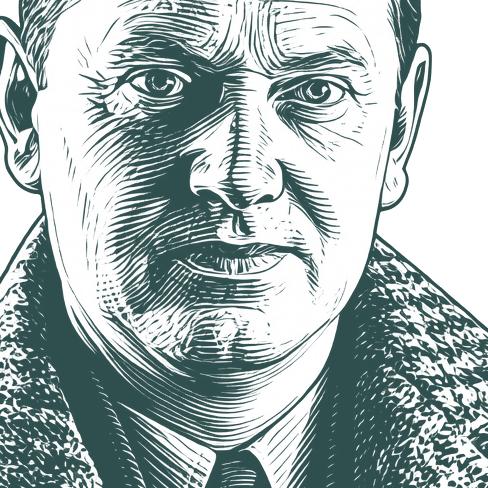
"Frankly," said the Doctor, "I am at a loss to understand my own emotions. I can think of no entertainment that fills me with greater detestation tha… - Evelyn Waugh
"Frankly," said the Doctor, "I am at a loss to understand my own emotions. I can think of no entertainment that fills me with greater detestation than a display of competitive athletics, none - except possibly folk dancing."
Arthur Evelyn St. John Waugh (28 October 1903 – 10 April 1966) was an English writer of novels, biographies, and travel books; he was also a prolific journalist and book reviewer. His most famous works include the early satires Decline and Fall (1928) and A Handful of Dust (1934), the novel Brideshead Revisited (1945), and the Second World War trilogy Sword of Honour (1952–1961). He is recognised as one of the great prose stylists of the English language in the 20th century.
Biography information from
Wikiquote·
Portrait adapted from
Wikimedia Commons, Carl Van Vechten (1880–1964) (Public domain / CC0)
Also Known As
Alternative Names:
Evelyn Arthur St John Waugh
•
Arthur Evelyn St. John Waugh
No.3 Commando was very anxious to be chums with Lord Glasgow, so they offered to blow up an old tree stump for him and he was very grateful and said don't spoil the plantation of young trees near it because that is the apple of my eye and they said no of course not we can blow a tree down so it falls on a sixpence and Lord Glasgow said goodness you are clever and he asked them all to luncheon for the great explosion. So Col. Durnford-Slater DSO said to his subaltern, have you put enough explosive in the tree?. Yes, sir, 75lbs. Is that enough? Yes sir I worked it out by mathematics it is exactly right. Well better put a bit more. Very good sir. And when Col. D Slater DSO had had his port he sent for the subaltern and said subaltern better put a bit more explosive in that tree. I don't want to disappoint Lord Glasgow. Very good sir. Then they all went out to see the explosion and Col. DS DSO said you will see that tree fall flat at just the angle where it will hurt no young trees and Lord Glasgow said goodness you are clever. So soon they lit the fuse and waited for the explosion and presently the tree, instead of falling quietly sideways, rose 50 feet into the air taking with it ½ acre of soil and the whole young plantation. And the subaltern said Sir, I made a mistake, it should have been 7½ not 75. Lord Glasgow was so upset he walked in dead silence back to his castle and when they came to the turn of the drive in sight of his castle what should they find but that every pane of glass in the building was broken. So Lord Glasgow gave a little cry and ran to hide his emotions in the lavatory and there when he pulled the plug the entire ceiling, loosened by the explosion, fell on his head. This is quite true.
My theme is memory, that winged host that soared about me one grey morning of war-time.
These memories, which are my life — for we possess nothing certainly except the past — were always with me. Like the pigeons of St. Mark's, theywere everywhere, under my feet, singly, in pairs, in little honey-voiced congregations, nodding, strutting, winking, rolling the tender feathers of their necks, perching sometimes, if I stood still, on my shoulder or pecking a broken biscuit from between my lips; until, suddenly, the noon gun boomed and in a moment, with a flutter and sweep of wings, the pavement was bare and the whole sky above dark with a tumult of fowl. Thus it was that morning.
These memories are the memorials and pledges of the vital hours of a lifetime. These hours of afflatus in the human spirit, the springs of art, are, in their mystery, akin to the epochs of history, when a race which for centuries has lived content, unknown, behind its own frontiers, digging, eating, sleeping, begetting, doing what was requisite for survival and nothing else, will, for a generation or two, stupefy the world; commit all manner of crimes, perhaps; follow the wildest chimeras, go down in the end in agony, but leave behind a record of new heights scaled and new rewards won for all mankind; the vision fades, the soul sickens, and the routine of survival starts again.
The human soul enjoys these rare, classic periods, but, apart from them, we are seldom single or unique; we keep company in this world with a hoard of abstractions and reflections and counterfeits of ourselves — the sensual man, the economic man, the man of reason, the beast, the machine and the sleep-walker, and heaven knows what besides, all in our own image, indistinguishable from ourselves to the outward eye. We get borne along, out of sight in the press, unresisting, till we get the chance to drop behind unnoticed, or to dodge down a side street, pause, breathe freely and take our bearings, or to push ahead, out-
Unlimited Quote Collections
Organize your favorite quotes without limits. Create themed collections for every occasion with Premium.
Nice to go to Rome. They are destroying all that was superficially attractive about my Church. It is a great sorrow to me and for once undeserved. If you see Cardinal Bea spit in his eye.