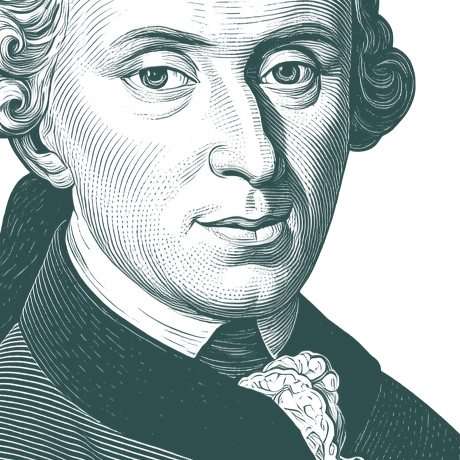
Let us suppose there was a teacher of whom an historical record (or, at least, a widespread belief which is not basically disputable) reports that he… - Immanuel Kant
""
Let us suppose there was a teacher of whom an historical record (or, at least, a widespread belief which is not basically disputable) reports that he was the first to expound publicly a pure and searching religion, comprehensible to the whole world. … Suppose that all he did was done even in the face of a dominant ecclesiastical faith which was onerous and not conducive to moral ends (a faith whose perfunctory worship can serve as a type of all the other faiths, at bottom merely statutory, which were current in the world at the time). Suppose, further, we find that he had made this universal religion of reason the highest and indispensable condition of every religious faith whatsoever … and this without further adding to this faith burdensome new ordinances or wishing to transform acts which he had initiated into peculiar holy practices, required in themselves as being constituent elements of religion. After this description one will not fail to recognize the person who can be referenced, not indeed as the founder of the religion which, free from every dogma, is engraved in all men’s hearts (for it does not have its origin in an arbitrary will), but as the founder of the first true church.
English
Collect this quote
About
Immanuel Kant
Immanuel Kant (22 April 1724 – 12 February 1804), born Emanuel Kant, was a German philosopher.
Biography information from
Wikiquote·
Portrait adapted from
Wikimedia Commons, Becker (Public domain / CC0)
Whereas the beautiful is limited, the sublime is limitless, so that the mind in the presence of the sublime, attempting to imagine what it cannot, has pain in the failure but pleasure in contemplating the immensity of the attempt
Sesuatu untuk dikerjakan, seseorang untuk dicintai, sesuatu untuk diharapkan. Itulah kebahagiaan.
The prejudices of the second species, since they impose upon the intellect by the sensual conditions restricting the mind if it wishes in certain cases to attain to what is intellectual, lurk more deeply. One of them is that which affects knowledge of quantity, the other that affecting knowledge of qualities generally. The former is: every actual multiplicity can be given numerically, and hence, every infinite quantity; the latter, whatever is impossible contradicts itself. In either of them the concept of time, it is true, does not enter into the very notion of the predicate, nor is it attributed as a qualification to the subject. But yet it serves as a means for forming an idea of the predicate, and thus, being a condition, affects the intellectual concept of the subject to the extent that the latter is only attained by its aid.