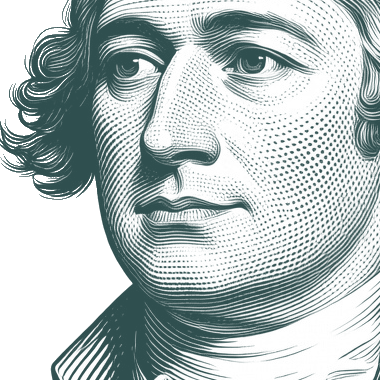
Men of factious tempers, of local prejudices, or of sinister designs, may, by intrigue, by corruption, or by other means, first obtain the suffrages,… - Alexander Hamilton
""
Men of factious tempers, of local prejudices, or of sinister designs, may, by intrigue, by corruption, or by other means, first obtain the suffrages, and then betray the interests, of the people.
Alexander Hamilton (11 January 1755 or 1757 – 12 July 1804) was a Founding Father of the United States, chief staff aide to General George Washington, one of the most influential interpreters and promoters of the U.S. Constitution, the founder of the nation's financial system, the founder of the Federalist Party, the world's first voter-based political party, the Father of the United States Coast Guard, and the founder of The New York Post.
Biography information from
Wikiquote·
Portrait adapted from
Wikimedia Commons, John Trumbull (Public domain / CC0)
Also Known As
Pen Names:
Publius
Alternative Names:
Hamilton
•
Alexander Hamilton, US Treasury secretary
•
A. Ham
But a man raised from the station of a private citizen to the rank of chief magistrate, possessed of a moderate or slender fortune, and looking forward to a period not very remote when he may probably be obliged to return to the station from which he was taken, might sometimes be under temptations to sacrifice his duty to his interest, which it would require superlative virtue to withstand. An avaricious man might be tempted to betray the interests of the state to the acquisition of wealth. An ambitious man might make his own aggrandizement, by the aid of a foreign power, the price of his treachery to his constituents.
It is impossible to read the history of the petty republics of Greece and Italy without feeling sensations of horror and disgust at the distractions with which they were continually agitated, and at the rapid succession of revolutions by which they were kept in a state of perpetual vibration between the extremes of tyranny and anarchy. If they exhibit occasional calms, these only serve as short-lived contrast to the furious storms that are to succeed. If now and then intervals of felicity open to view, we behold them with a mixture of regret, arising from the reflection that the pleasing scenes before us are soon to be overwhelmed by the tempestuous waves of sedition and party rage.
Go Premium
Support Quotewise while enjoying an ad-free experience and premium features.
I go further, and affirm that bills of rights, in the sense and to the extent in which they are contended for, are not only unnecessary in the proposed Constitution, but would even be dangerous. They would contain various exceptions to powers not granted; and, on this very account, would afford a colorable pretext to claim more than were granted. For why declare that things shall not be done which there is no power to do?