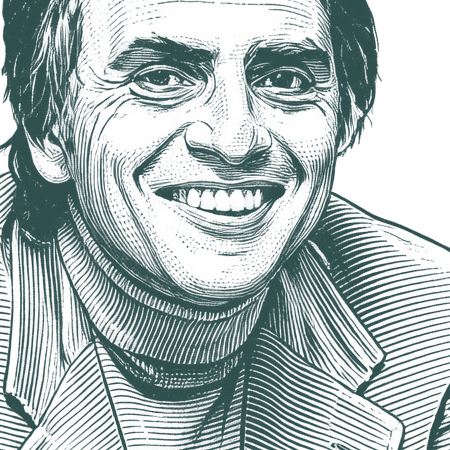
Claims that cannot be tested, assertions immune to disproof are veridically worthless, whatever value they may have in inspiring us or in exciting ou… - Carl Sagan
""
Claims that cannot be tested, assertions immune to disproof are veridically worthless, whatever value they may have in inspiring us or in exciting our sense of wonder.
English
Collect this quote
About
Carl Sagan
Carl Edward Sagan (9 November 1934 – 20 December 1996) was an American astronomer, planetary scientist, cosmologist, astrophysicist, astrobiologist, author, and science communicator. His best known scientific contribution is research on extraterrestrial life, including experimental demonstration of the production of amino acids from basic chemicals by radiation. Sagan assembled the first physical messages sent into space, the Pioneer plaque and the Voyager Golden Record, universal messages that could potentially be understood by any extraterrestrial intelligence that might find them. Sagan argued the hypothesis, accepted since, that the high surface temperatures of Venus can be attributed to, and calculated using, the greenhouse effect. He testified to the US Congress in 1985 that the greenhouse effect will change the earth's climate system.
Biography information from
Wikiquote·
Portrait adapted from
Wikimedia Commons, NASA/JPL (Public domain / CC0)
Also Known As
Native Name:
Carl Edward Sagan
Alternative Names:
Sagan
•
Carl E. Sagan
•
Carl E Sagan
•
C. E. Sagan
•
C.E. Sagan
•
C E Sagan
•
C. Sagan
•
C Sagan
•
Sagan C
•
Sagan C.
•
Sagan C. E.
•
Sagan CE
I believe that even a smattering of such findings in modern science and mathematics is far more compelling and exciting than most of the doctrines of pseudoscience, whose practitioners were condemned as early as the fifth century B.C. by the Ionian philosopher Heraclitus as “nightwalkers, magicians, priests of Bacchus, priestesses of the wine-vat, mystery-mongers.” But science is more intricate and subtle, reveals a much richer universe, and powerfully evokes our sense of wonder. And it has the additional and important virtue—to whatever extent the word has any meaning—of being true.
Galileo’s own description of his ecclesiastical travails is contained in a letter he wrote in the year 1615 to the Grand Duchess Christina: Some years ago as Your Serene Highness well knows, I discovered in the heavens many things that had not been seen before our own age. The novelty of these things, as well as some consequences which followed from them in contradiction to the physical notions commonly held among academic philosophers, stirred up against me no small number of professors [many of them ecclesiastics] — as if I had placed these things in the sky with my own hands in order to upset Nature and overturn the sciences. They seemed to forget that the increase of known truths stimulates the investigation, establishment, and growth of the arts.
Go Premium
Support Quotewise while enjoying an ad-free experience and premium features.
But our openness to the dazzling possibilities presented by modern science must be tempered by some hard-nosed skepticism. Many interesting possibilities simply turn out to be wrong. An openness to new possibilities and a willingness to ask hard questions are both required to advance our knowledge. And the asking of tough questions has an ancillary benefit: political and religious life in America, especially in the last decade and a half, has been marked by an excessive public credulity, an unwillingness to ask difficult questions, which has produced a demonstrable impairment in our national health. Consumer skepticism makes quality products. This may be why governments and churches and school systems do not exhibit unseemly zeal in encouraging critical thought. They know they themselves are vulnerable.