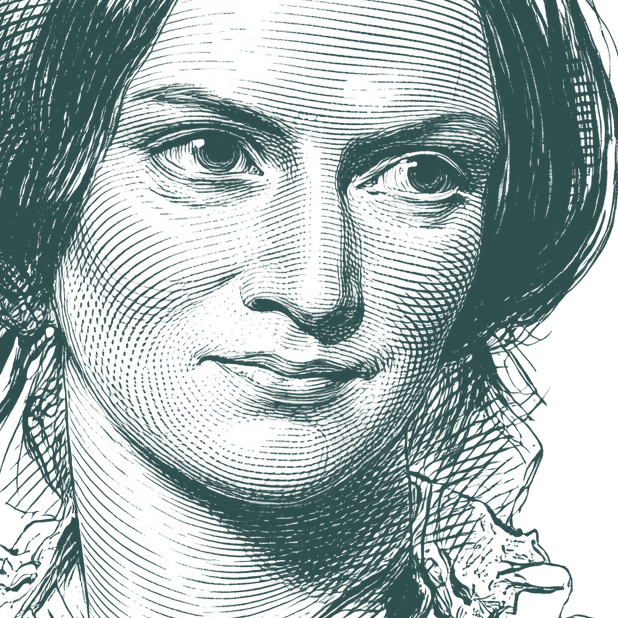
At heart, he could not abide sense in women: he liked to see them as silly, as light-headed, as vain, as open to ridicule as possible; because they w… - Charlotte Brontë
""
At heart, he could not abide sense in women: he liked to see them as silly, as light-headed, as vain, as open to ridicule as possible; because they were then in reality what he held them to be, and wished them to be, — inferior: toys to play with, to amuse a vacant hour and to be thrown away.
Charlotte Brontë (21 April 1816 – 31 March 1855) was an English novelist, the eldest of the three Brontë sisters, who first published her work under the pseudonym Currer Bell.
Biography information from
Wikiquote·
Portrait adapted from
Wikimedia Commons, George Richmond (Public domain / CC0)
Also Known As
Alternative Names:
Tree
•
Florian Wellesley
•
Lord Charles Albert
•
Captain Tree
•
Charles Wellesley
•
Charlotte Bronte
•
Currer Bell
•
Karlotta Bronte
•
Douro
•
Mrs. A. B. Nicholls
•
Charlotte Nicholls
•
Sharlotta Bronte
•
Mrs. Arthur Bell NichollsMrs. Arthur Bell Nicholls
At that time, I well remember whatever could excite - certain accidents of the weather, for instance, were almost dreaded by me, because they woke the being I was always lulling, and stirred up a craving cry I could not satisfy. One night a thunder-storm broke; a sort of hurricane shook us in our beds: the Catholics rose in panic and prayed to their saints. As for me, the tempest took hold of me with tyranny: I was roughly roused and obliged to live. I got up and dressed myself, and creeping outside the basement close by my bed, sat on its ledge, with my feet on the roof of a lower adjoining building. It was wet, it was wild, it was pitch dark. Within the dormitory they gathered round the night-lamp in consternation, praying loud. I could not go in: too resistless was the delight of staying with the wild hour, black and full of thunder, pealing out such an ode as language never delivered to man - too terribly glorious, the spectacle of clouds, split and pierced by white and blinding bolts.