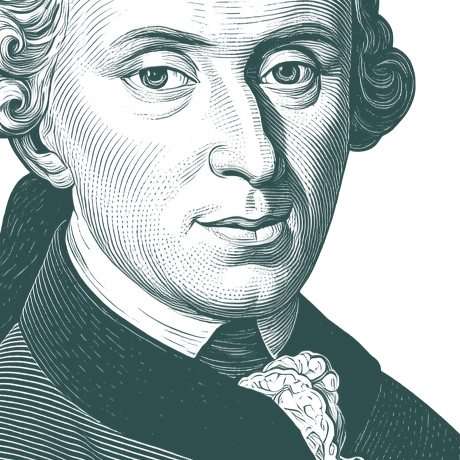
The second is the partiality for unity proper to the philosophical mind, whence this wide-spread canon has flown forth: principles are not to be mult… - Immanuel Kant
""
The second is the partiality for unity proper to the philosophical mind, whence this wide-spread canon has flown forth: principles are not to be multiplied beyond supreme necessity, to which we give in our adhesion, not because we have insight into causal unity in the world either by reason or experience, but as seeking it by an impulse of the intellect which seems to itself to have by thus much advanced in the explication of phenomena, by as much as it is granted to it to descend from the same principle to a greater number of consequences,
Since men in their endeavors behave, on the whole, not just instinctively, like the brutes, nor yet like rational citizens of the world according to some agreed-on plan, no history of man conceived according to a plan seems to be possible, as it might be possible to have such a history of bees or beavers. One cannot suppress a certain indignation when one sees men’s actions on the great world-stage and finds, beside the wisdom that appears here and there among individuals, everything in the large woven together from folly, childish vanity, even from childish malice and destructiveness. In the end, one does not know what to think of the human race, so conceited in its gifts.
The man of principles has character. Of him we know definitely what to expect. He does not act on the basis of his instinct, but on the basis of his will. Therefore, without being redundant one can classify characteristics according to a person's faculty of desire (what is practical), as a) his nature, or natural talent, b) his temperament, or disposition, and c) his general character, or mode of thinking.
PREMIUM FEATURE
Advanced Search Filters
Filter search results by source, date, and more with our premium search tools.
Since the human race's natural end is to make steady cultural progress, its moral end is to be conceived as progressing toward the better. And this progress may well be occasionally interrupted, but it will never be broken off.