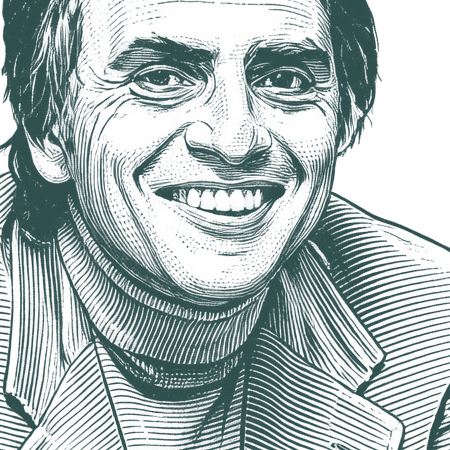
Think of the rivers of blood, spilled by all those generals and emperors, so that in glory and triumph, they could become the momentary masters, of a… - Carl Sagan
""
Think of the rivers of blood, spilled by all those generals and emperors, so that in glory and triumph, they could become the momentary masters, of a fraction of a dot...our posturings, our imagined self-importance, the delusion that we have some privileged position in the universe - are challenged by that point of pale light.
English
Collect this quote
About
Carl Sagan
Carl Edward Sagan (9 November 1934 – 20 December 1996) was an American astronomer, planetary scientist, cosmologist, astrophysicist, astrobiologist, author, and science communicator. His best known scientific contribution is research on extraterrestrial life, including experimental demonstration of the production of amino acids from basic chemicals by radiation. Sagan assembled the first physical messages sent into space, the Pioneer plaque and the Voyager Golden Record, universal messages that could potentially be understood by any extraterrestrial intelligence that might find them. Sagan argued the hypothesis, accepted since, that the high surface temperatures of Venus can be attributed to, and calculated using, the greenhouse effect. He testified to the US Congress in 1985 that the greenhouse effect will change the earth's climate system.
Biography information from
Wikiquote·
Portrait adapted from
Wikimedia Commons, NASA/JPL (Public domain / CC0)
Also Known As
Native Name:
Carl Edward Sagan
Alternative Names:
Sagan
•
Carl E. Sagan
•
Carl E Sagan
•
C. E. Sagan
•
C.E. Sagan
•
C E Sagan
•
C. Sagan
•
C Sagan
•
Sagan C
•
Sagan C.
•
Sagan C. E.
•
Sagan CE
Related quotes. More quotes will automatically load as you scroll down, or you can use the load more buttons.
Shorter versions of this quote
.. Think of the rivers of blood spilled by all those generals and emperors so that in glory and in triumph they could become the 'Momentary' masters of a 'Fraction' of a 'Dot'
Our posturings, our imagined self-importance, the delusion that we have some privileged position in the Universe, are challenged by this point of pale light.
OUR ANCESTORS UNDERSTOOD origins by extrapolating from their own experience. How else could they have done it? So the Universe was hatched from a cosmic egg, or conceived in the sexual congress of a mother god and a father god, or was a kind of product of the Creator’s workshop — perhaps the latest of many flawed attempts. And the Universe was not much bigger than we see, and not much older than our written or oral records, and nowhere very different from places that we know. We’ve tended in our cosmologies to make things familiar. Despite all our best efforts, we’ve not been very inventive.
Cuando los hombres descubren algo nuevo sienten una inclinación natural a hacer uso de ello, probablemente en respuesta a sus circuitos cerebrales. Esa extraña proclividad, que no comparten de modo sistemático las demás bestias o plantas de la Tierra, constituye tanto una causa principal del éxito humano como un motivo básico de que estemos despojando una parte tan considerable de la superficie terráquea. Las aves saben, mejor que los humanos, que no deben ensuciar su nido.
PREMIUM FEATURE
Advanced Search Filters
Filter search results by source, date, and more with our premium search tools.
As long as there have been humans, we have searched for our place in the Cosmos. In the childhood of our species (when our ancestors gazed a little idly at the stars), among the Ionian scientists of ancient Greece, and in our own age, we have been transfixed by this question: Where are we? Who are we? We find that we live on an insignificant planet of a humdrum star lost between two spiral arms in the outskirts of a galaxy which is a member of a sparse cluster of galaxies, tucked away in some forgotten corner of a universe in which there are far more galaxies than people. This perspective is a courageous continuation of our penchant for constructing and testing mental models of the skies; the Sun as a red-hot stone, the stars as celestial flame, the Galaxy as the backbone of night. Since Aristarchus, every step in our quest has moved us farther from center stage in the cosmic drama. There has not been much time to assimilate these new findings. The discoveries of Shapley and Hubble were made within the lifetimes of many people still alive today. There are those who secretly deplore these great discoveries, who consider every step a demotion, who in their heart of hearts still pine for a universe whose center, focus and fulcrum is the Earth. But if we are to deal with the Cosmos we must first understand it, even if our hopes for some unearned preferential status are, in the process, contravened. Understanding where we live is an essential precondition for improving the neighborhood. Knowing what other neighborhoods are like also helps. If we long for our planet to be important, there is something we can do about it. We make our world significant by the courage of our questions and by the depth of our answers. We embarked on our cosmic voyage with a question first framed in the childhood of our species and in each generation asked anew with undiminished wonder: What are the stars? Exploration is in our nature. We began as wanderers, and we are wanderers still. We have