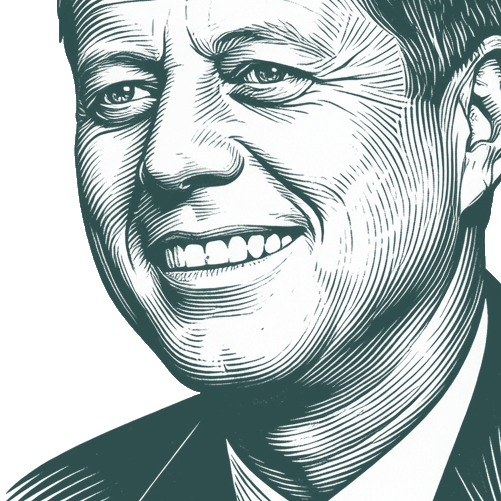
Today some would say that those struggles are all over — that all the horizons have been explored — that all the battles have been won — that there i… - John F. Kennedy
""
Today some would say that those struggles are all over — that all the horizons have been explored — that all the battles have been won — that there is no longer an American frontier. But I trust that no one in this vast assemblage will agree with those sentiments. For the problems are not all solved and the battles are not all won — and we stand today on the edge of a New Frontier — the frontier of the 1960's — a frontier of unknown opportunities and perils — a frontier of unfulfilled hopes and threats.
English
Collect this quote
About
John F. Kennedy
John Fitzgerald Kennedy (29 May 1917 – 22 November 1963), often referred to by his initials JFK and Jack, was the 35th president of the United States (1961–1963), a United States senator from Massachusetts (1953–1960), and a United States representative (1947–1953). Kennedy served at the height of the Cold War, and the majority of his work as president concerned relations with the Soviet Union and Cuba. He is the older brother of Robert F. Kennedy and Ted Kennedy, and the first husband of Jacqueline Kennedy Onassis. He was shot in the presence of his wife in Dallas on November 22, 1963.
Portrait adapted from
Wikimedia Commons, Cecil W. Stoughton (Public domain / CC0)
Also Known As
Birth Name:
John Fitzgerald Kennedy
Also Known As:Jack
Alternative Names:
Kennedy
•
Jack Kennedy
•
President Kennedy
•
J. F. Kennedy
•
JFK
•
John Kennedy
•
John Fitzgerald "Jack" Kennedy
•
JF Kennedy
•
John F Kennedy
He "said to one of the highest officials of his Administration that he wanted 'to splinter the C.I.A. in a thousand pieces and scatter it to the winds.'"
For the unity of freedom has never relied on uniformity of opinion.
Works in ChatGPT, Claude, or Any AI
Add semantic quote search to your AI assistant via MCP. One command setup.
What is true of this city is true of Germany — real, lasting peace in Europe can never be assured as long as one German out of four is denied the elementary right of free men, and that is to make a free choice. In 18 years of peace and good faith, this generation of Germans has earned the right to be free, including the right to unite their families and their nation in lasting peace, with good will to all people. You live in a defended island of freedom, but your life is part of the main. So let me ask you as I close, to lift your eyes beyond the dangers of today, to the hopes of tomorrow, beyond the freedom merely of this city of Berlin, or your country of Germany, to the advance of freedom everywhere, beyond the wall to the day of peace with justice, beyond yourselves and ourselves to all mankind.