Modern Roman Catholicism has no quarrel with the Big Bang, with a Universe 15 billion or so years old, with the first living things arising from preb… - Carl Sagan
""
Modern Roman Catholicism has no quarrel with the Big Bang, with a Universe 15 billion or so years old, with the first living things arising from prebiological molecules, or with humans evolving
English
Collect this quote
About
Carl Sagan
Carl Edward Sagan (9 November 1934 – 20 December 1996) was an American astronomer, planetary scientist, cosmologist, astrophysicist, astrobiologist, author, and science communicator. His best known scientific contribution is research on extraterrestrial life, including experimental demonstration of the production of amino acids from basic chemicals by radiation. Sagan assembled the first physical messages sent into space, the Pioneer plaque and the Voyager Golden Record, universal messages that could potentially be understood by any extraterrestrial intelligence that might find them. Sagan argued the hypothesis, accepted since, that the high surface temperatures of Venus can be attributed to, and calculated using, the greenhouse effect. He testified to the US Congress in 1985 that the greenhouse effect will change the earth's climate system.
Biography information from
Wikiquote·
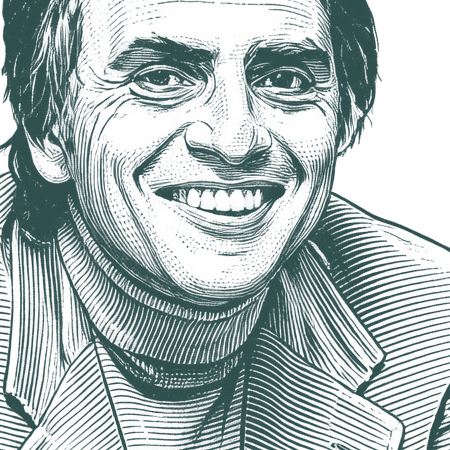
Portrait adapted from
Wikimedia Commons, NASA/JPL (Public domain / CC0)
Also Known As
Native Name:
Carl Edward Sagan
Alternative Names:
Sagan
•
Carl E. Sagan
•
Carl E Sagan
•
C. E. Sagan
•
C.E. Sagan
•
C E Sagan
•
C. Sagan
•
C Sagan
•
Sagan C
•
Sagan C.
•
Sagan C. E.
•
Sagan CE
Skeptical scrutiny is the means, in both science and religion, by which deep thoughts can be winnowed from deep nonsense.
"In a time in some respect similar to our own, St. Augustine of Hippo, after a lusty and intellectually inventive young manhood, withdrew from the world of sense and intellect and advised others to do likewise; "There is another form of temptation, even more fraught with danger. This is the disease of curiosity... It is this which drives us on to try to discover the secrets of nature, those secrets which are beyond our understanding, which can avail us nothing and which men should not wish to learn... In this immense forest full of pitfalls and perils, I have drawn myself back, and pulled myself away from these thorns. In the midst of all these things which float unceasingly around me in everyday life, I am never surprised at any of them, and never captivated by my genuine desire to study them... I no longer dream about the stars." The time of Augustine's death, 430 ce., marks the beginning of the Dark Age in Europe."
Try QuoteGPT
Chat naturally about what you need. Each answer links back to real quotes with citations.
The organic molecules found in the gas phase in the atmosphere of Titan by Voyager 1 and 2 spacecraft include hydrogen cyanide, cyanoacetylene, butadiene. cyanogen, propylene, propane, acetylene, ethane, ethylene, Methane, likewise. And the principle constituent of the atmosphere, there as here, is molecular nitrogen. It is, I think, very interesting that we have a world in the outer solar system that is loaded with the stuff of life.