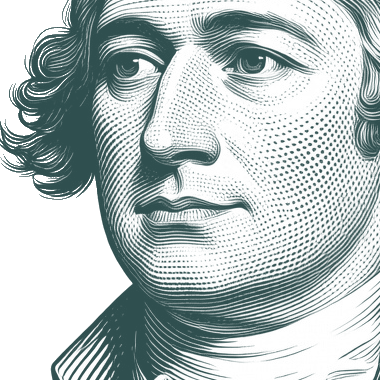
A prudent silence will frequently be taken for wisdom and a sentence or two cautiously thrown in will sometimes gain the palm of knowledge, while a m… - Alexander Hamilton
""
A prudent silence will frequently be taken for wisdom and a sentence or two cautiously thrown in will sometimes gain the palm of knowledge, while a man well informed but indiscreet and unreserved will not uncommonly talk himself out of all consideration and weight.
Alexander Hamilton (11 January 1755 or 1757 – 12 July 1804) was a Founding Father of the United States, chief staff aide to General George Washington, one of the most influential interpreters and promoters of the U.S. Constitution, the founder of the nation's financial system, the founder of the Federalist Party, the world's first voter-based political party, the Father of the United States Coast Guard, and the founder of The New York Post.
Biography information from
Wikiquote·
Portrait adapted from
Wikimedia Commons, John Trumbull (Public domain / CC0)
Also Known As
Pen Names:
Publius
Alternative Names:
Hamilton
•
Alexander Hamilton, US Treasury secretary
•
A. Ham
In no part of the constitution is more wisdom to be found than in the clause which confides the question of war or peace to the legislature, and not to the executive department. Beside the objection to such a mixture of heterogeneous powers: the trust and the temptation would be too great for any one man: not such as nature may offer as the prodigy of many centuries, but such as may be expected in the ordinary successions of magistracy. War is in fact the true nurse of executive aggrandizement. In war a physical force is to be created, and it is the executive will which is to direct it. In war the public treasures are to be unlocked, and it is the executive hand which is to dispense them. In war the honors and emoluments of office are to be multiplied; and it is the executive patronage under which they are to be enjoyed. It is in war, finally, that laurels are to be gathered, and it is the executive brow they are to encircle. The strongest passions, and most dangerous weaknesses of the human breast; ambition, avarice, vanity, the honorable or venial love of fame, are all in conspiracy against the desire and duty of peace.
I believe the British government forms the best model the world ever produced, and such has been its progress in the minds of the many, that this truth gradually gains ground. This government has for its object public strength and individual security. It is said with us to be unattainable. All communities divide themselves into the few and the many. The first are the rich and well born, the other the mass of the people. The voice of the people has been said to be the voice of God; and however generally this maxim has been quoted and believed, it is not true in fact. The people are turbulent and changing; they seldom judge or determine right. Give therefore to the first class a distinct, permanent share in the government. They will check the unsteadiness of the second, and as they cannot receive any advantage by a change, they therefore will ever maintain good government. Can a democratic assembly, who annually revolve in the mass of the people, be supposed steadily to pursue the public good?
Go Premium
Support Quotewise while enjoying an ad-free experience and premium features.
Hence, slow and scanty levies of men, in the most critical emergencies of our affairs; short enlistments at an unparalleled expense; continual fluctuations in the troops, ruinous to their discipline and subjecting the public safety frequently to the perilous crisis of a disbanded army. Hence, also, those oppressive expedients for raising men which were upon several occasions practiced, and which nothing but the enthusiasm of liberty would have induced the people to endure.