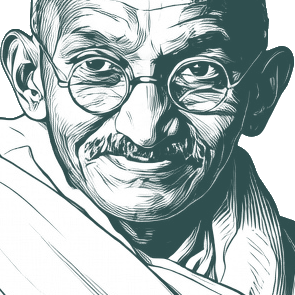
The chief agency for keeping the blood pure is the air. When the blood returns to the lungs after one complete round over the body, it is impure and … - Mahatma Gandhi
""
The chief agency for keeping the blood pure is the air. When the blood returns to the lungs after one complete round over the body, it is impure and contains poisonous elements. The oxygen of the air which we inhale purifies this blood and is assimilated into it, while the nitrogen absorbs the poisonous matter and is breathed out. ... The air which we inhale is taken into the lungs through the windpipe, and the blood is purified by it. It is of the utmost importance to breathe through the nose, instead of through the mouth. (Chapter II, The Human Body)
Mohandas Karamchand Gandhi (2 October 1869 – 30 January 1948) was an Indian lawyer, anti-colonial nationalist and political ethicist who employed nonviolent resistance to lead the successful campaign for India's independence from British rule, and to later inspire movements for civil rights and freedom across the world. The honorific Mahātmā (Sanskrit: "great-souled", "venerable"), first applied to him in 1914 in South Africa, is now used throughout the world.
Biography information from
Wikiquote·
Portrait adapted from
Wikimedia Commons, Elliott & Fry (Public domain / CC0)
Also Known As
Native Name:
મોહનદાસ ગાંધી
Alternative Names:
M. K. Gandhi
•
Mohandas K Gandhi
•
M K Gandhi
•
Mohandas Gandhi
•
Gandhi
•
Mohandas K. Gandhi
•
Gandhiji
•
Bapuji
•
Father of the Nation
•
Bapu
•
Mahatma Mohandas Karamchand Gandhi
•
Mohandas Karamchand Gandhi
•
MK Gandhi
Ours is one continual struggle against a degradation sought to be inflicted upon us by the Europeans, who desire to degrade us to the level of the raw Kaffir whose occupation is hunting, and whose sole ambition is to collect a certain number of cattle to buy a wife with and, then, pass his life in indolence and nakedness.
Harijan, (2 January 1942), p. 27
Limited Time Offer
Premium members can get their quote collection automatically imported into their Quotewise collections.