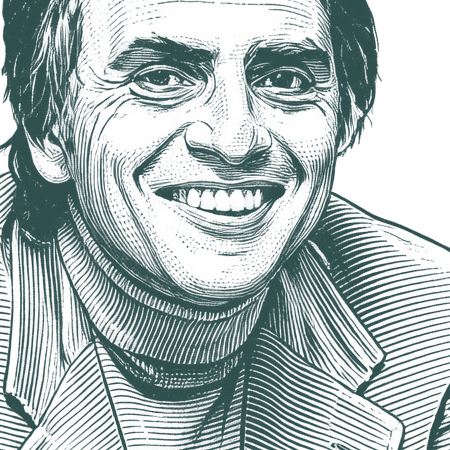
This doesn't mean you can picture a billion or a quintillion objects in your head—nobody can. But, with exponential notation, we can think about and … - Carl Sagan
""
This doesn't mean you can picture a billion or a quintillion objects in your head—nobody can. But, with exponential notation, we can think about and calculate with such numbers. Pretty good for self-taught beings who started out with no possessions and who could number their fellows on their fingers and toes.
English
Collect this quote
About
Carl Sagan
Carl Edward Sagan (9 November 1934 – 20 December 1996) was an American astronomer, planetary scientist, cosmologist, astrophysicist, astrobiologist, author, and science communicator. His best known scientific contribution is research on extraterrestrial life, including experimental demonstration of the production of amino acids from basic chemicals by radiation. Sagan assembled the first physical messages sent into space, the Pioneer plaque and the Voyager Golden Record, universal messages that could potentially be understood by any extraterrestrial intelligence that might find them. Sagan argued the hypothesis, accepted since, that the high surface temperatures of Venus can be attributed to, and calculated using, the greenhouse effect. He testified to the US Congress in 1985 that the greenhouse effect will change the earth's climate system.
Biography information from
Wikiquote·
Portrait adapted from
Wikimedia Commons, NASA/JPL (Public domain / CC0)
Also Known As
Native Name:
Carl Edward Sagan
Alternative Names:
Sagan
•
Carl E. Sagan
•
Carl E Sagan
•
C. E. Sagan
•
C.E. Sagan
•
C E Sagan
•
C. Sagan
•
C Sagan
•
Sagan C
•
Sagan C.
•
Sagan C. E.
•
Sagan CE
It is called Giordano Bruno after the sixteenth-century Roman Catholic scholar who held that there are an infinity of worlds and that many are inhabited. For this and other crimes he was burned at the stake in the year 1600.
Once we lose our fear of being tiny, we find ourselves on the threshold of a vast and awesome Universe which dwarfs — in time, in space, and in potential — the tidy anthropocentric proscenium of our ancestors.
The Cardiff Giant that most Americans have seen is this copy. Barnum exhibited a fake fake.