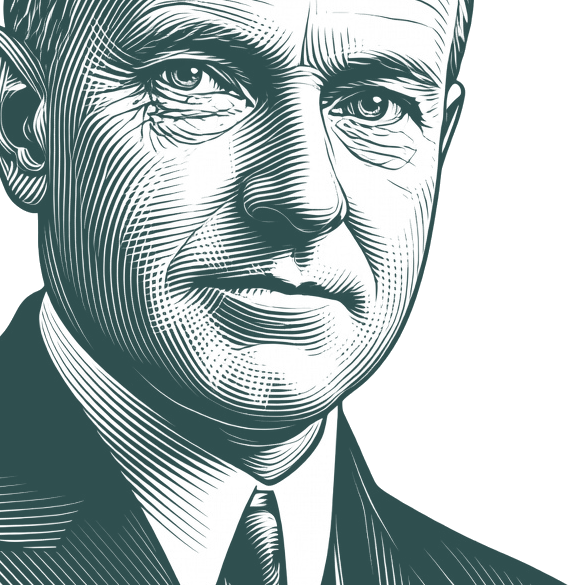
It would not be unjust to ask of every alien: What will you contribute to the common good, once you are admitted through the gates of liberty? Our hi… - Calvin Coolidge
""
It would not be unjust to ask of every alien: What will you contribute to the common good, once you are admitted through the gates of liberty? Our history is full of answers of which we might be justly proud. But of late, the answers have not been so readily or so eloquently given. Our country must cease to be regarded as a dumping ground. Which does not mean that it must deny the value of rich accretions drawn from the right kind of immigration. Any such restriction, except as a necessary and momentary expediency, would assuredly paralyze our national vitality. But measured practically, it would be suicidal for us to let down the bars for the inflowing of cheap manhood, just as, commercially, it would be unsound for this country to allow her markets to be overflooded with cheap goods, the product of a cheap labor. There is no room either for the cheap man or the cheap goods.
John Calvin Coolidge Jr. (4 July 1872 – 5 January 1933) was the 30th president of the United States (1923–29). A Republican lawyer from Vermont, Coolidge worked his way up the ladder of Massachusetts state politics, eventually becoming governor of that state. His response to the Boston Police Strike of 1919 thrust him into the national spotlight and gave him a reputation as a man of decisive action. Soon after, he was elected as the 29th vice president in 1920 and succeeded to the presidency upon the sudden death of Warren G. Harding in 1923. Elected in his own right in 1924, he gained a reputation as a small-government conservative.
Biography information from
Wikiquote·
Portrait adapted from
Wikimedia Commons, Harris & Ewing (Public domain / CC0)
Also Known As
Birth Name:
John Calvin
Alternative Names:
John Calvin Coolidge Jr.
•
John Calvin Coolidge
•
President Coolidge
•
J. C. Coolidge
•
C. Coolidge
•
Silent Cal
•
Silent Cal Coolidge
To continue to be independent we must continue to be whole-hearted American. We must direct our policies and lay our course with the sole consideration of serving our own people. We cannot become the partisans of one nation, or the opponents of another. Our domestic affairs should be entirely free from foreign interference, whether such attempt be made by those who are without or within our own territory. America is a large country. It is a tolerant country. It has room within its borders for many races and many creeds. But it has no room for those who would place the interests of some other nation above the interests of our own nation.
For some reason I was attracted to civil government and took that. This was my first introduction to the Constitution of the United States. Although I was but thirteen years old the subject interested me exceedingly. The study of it which I then began has never ceased, and the more I study it the more I have come to admire it, realizing that no other document devised by the hand of man ever brought so much progress and happiness to humanity. The good it has wrought can never be measured.
Enhance Your Quote Experience
Enjoy ad-free browsing, unlimited collections, and advanced search features with Premium.
This was an age-old conflict. At its foundation lies the question of how can the Government govern and the people be free? How can organized society make and enforce laws and the individual remain independent? There is no short sighted answer to these inquiries. Whatever may have been the ambiguity in the Federal Constitution, of course the Union had to be supreme within its sphere or cease to be a Union. It was also certain and obvious that each State had to be sovereign within its sphere or cease to be a State.