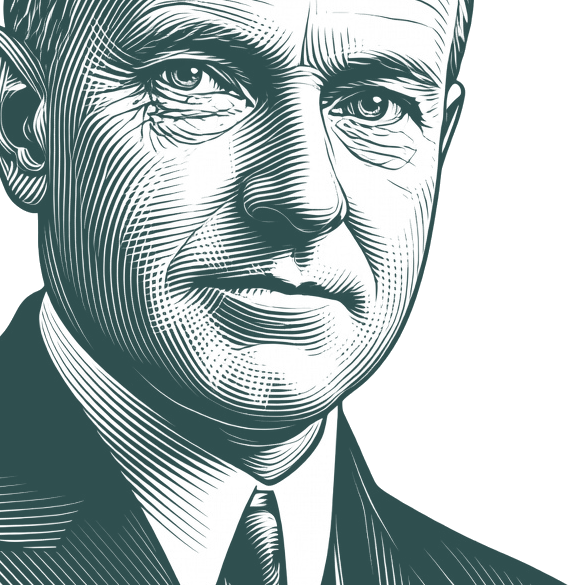
John Calvin Coolidge Jr. (4 July 1872 – 5 January 1933) was the 30th president of the United States (1923–29). A Republican lawyer from Vermont, Coolidge worked his way up the ladder of Massachusetts state politics, eventually becoming governor of that state. His response to the Boston Police Strike of 1919 thrust him into the national spotlight and gave him a reputation as a man of decisive action. Soon after, he was elected as the 29th vice president in 1920 and succeeded to the presidency upon the sudden death of Warren G. Harding in 1923. Elected in his own right in 1924, he gained a reputation as a small-government conservative.
Biography information from
Wikiquote·
Portrait adapted from
Wikimedia Commons, Harris & Ewing (Public domain / CC0)
Also Known As
Birth Name:
John Calvin
Alternative Names:
John Calvin Coolidge Jr.
•
John Calvin Coolidge
•
President Coolidge
•
J. C. Coolidge
•
C. Coolidge
•
Silent Cal
•
Silent Cal Coolidge
I want to see all Americans have a reasonable amount of leisure. Then I want to see them educated to use such leisure for their own enjoyment and betterment, and the strengthening of the quality of their citizenship. We can go a long way in that direction by getting them out of doors and really interested in nature. We can make still further progress by engaging them in games and sports. Our country is a land of cultured men and women. It is a land of agriculture, of industries, of schools, and of places of religious worship. It is a land of varied climes and scenery, of mountain and plain, of lake and river. It is the American heritage. We must make it a land of vision, a land of work, of sincere striving for the good, but we must add to all these, in order to round out the full stature of the people, an ample effort to make it a land of wholesome enjoyment and perennial gladness.
To continue to be independent we must continue to be whole-hearted American. We must direct our policies and lay our course with the sole consideration of serving our own people. We cannot become the partisans of one nation, or the opponents of another. Our domestic affairs should be entirely free from foreign interference, whether such attempt be made by those who are without or within our own territory. America is a large country. It is a tolerant country. It has room within its borders for many races and many creeds. But it has no room for those who would place the interests of some other nation above the interests of our own nation.
Try QuoteGPT
Chat naturally about what you need. Each answer links back to real quotes with citations.
It has been in accordance with these principles that we have made generous settlements of our foreign debts. The little sentiment of "live and let live" expresses a great truth. It has been thought wise to extend the payment of our debts over a long period of years, with a very low rate of interest, in order to relieve foreign peoples of the burden of economic pressure beyond their capacity to bear. An adjustment has now been made of all these major obligations, and they have all but one been mutually ratified. The moral principle of the payment of international debts has been preserved. Every dollar that we have advanced to these countries they have promised to repay with some interest. Our National Treasury is not in the banking business. We did not make these loans as a banking enterprise. We made them to a very large extent as an incident to the prosecution of the war. We have not sought to adjust them on a purely banking basis. We have taken into consideration all the circumstances and the elements that attended the original transaction and all the results that will probably flow from their settlement. They have been liquidated on this broad moral and humanitarian basis. We believe that the adjustments which have been made will be mutually beneficial to the trade relations of the countries involved and that out of these economic benefits there will be derived additional guaranties to the stability and peace of the world.