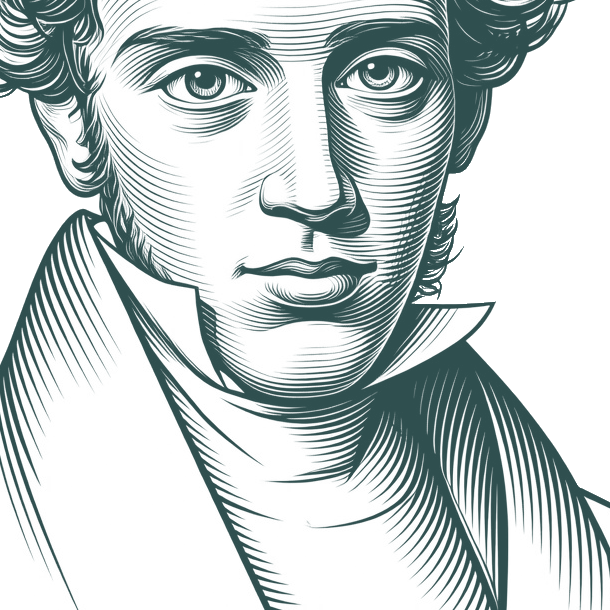
Philosophy cannot and should not give us an account of faith, but should understand itself and know just what it has indeed to offer, without taking … - Søren Kierkegaard
""
Philosophy cannot and should not give us an account of faith, but should understand itself and know just what it has indeed to offer, without taking anything away, least of all cheating people out of something by making them think it is nothing.
Søren Aabye Kierkegaard (5 May 1813 – 11 November 1855) was a Danish Christian philosopher and theologian, considered to be a founder of Existentialist thought and Absurdist traditions. He wrote critical texts on organized religion, Christendom, morality, ethics, psychology and philosophy of religion, displaying a fondness for metaphor, irony and parables.
Biography information from
Wikiquote·
Portrait adapted from
Wikimedia Commons, La Biblioteca Real de Dinamarca (Public domain / CC0)
Also Known As
Pen Names:
Victor Eremita
•
A
•
Judge William
•
Johannes de silentio
•
Constantine Constantius
•
Young Man
•
Vigilius Haufniensis
•
Nicolaus Notabene
•
Hilarius Bookbinder
•
Johannes Climacus
•
Inter et Inter
•
H.H.
•
Anti-Climacus
•
B
•
Johannes de Silentio
•
Constantin Constantius
•
P. CH. Kierkegaard
Native Name:
Søren Aabye Kierkegaard
Alternative Names:
Kierkegaard
•
Climacus
•
Sören Aaby Kierkegaard
I have the courage, I believe, to doubt everything; I have the courage, I believe, to fight with everything; but I have not the courage to know anything; not the courage to possess, to own anything. Most people complain that the world is so prosaic, that life is not like romance, where opportunities are always so favorable. I complain that life is not like romance, where one had hard-hearted parents and nixies and trolls to fight, and enchanted princesses to free. What are all such enemies taken together, compared with the pale, bloodless, tenacious, nocturnal shapes with which I fight, and to whom I give life and substance?
If one prefers to have little with blessing, to have truth with concern, to suffer instead of exulting over imagined victories, then one presumably will not be disposed to praise the knowledge, as if what it bestows were at all proportionate to the trouble it causes, although one would not therefore deny that through its pain it educates a person, if he is honest enough to want to be educated rather than to be deceived, out of the multiplicity to seek the one, out of abundance to seek the one thing needful, as this is plainly and simply offered precisely according to the need for it.
Enhance Your Quote Experience
Enjoy ad-free browsing, unlimited collections, and advanced search features with Premium.
How absurd men are! They never use the liberties they have, they demand those they do not have. They have freedom of thought, they demand freedom of speech.