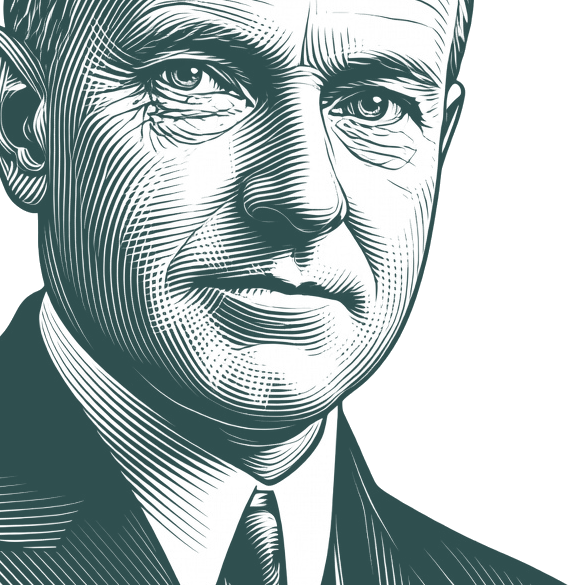
These are points to consider when we put our house in order for the advancing hordes of aliens. Experience has taught us to have faith in the bulk of… - Calvin Coolidge
""
These are points to consider when we put our house in order for the advancing hordes of aliens. Experience has taught us to have faith in the bulk of our people. The great decisions in American history have always been right. The heart of the nation is sound and must be kept sound. It is a characteristic of ours that we are ashamed not to be right. I believe that our present concern about immigration is a fear that we will not be able to protect ourselves and at the same time discharge our obligations.
John Calvin Coolidge Jr. (4 July 1872 – 5 January 1933) was the 30th president of the United States (1923–29). A Republican lawyer from Vermont, Coolidge worked his way up the ladder of Massachusetts state politics, eventually becoming governor of that state. His response to the Boston Police Strike of 1919 thrust him into the national spotlight and gave him a reputation as a man of decisive action. Soon after, he was elected as the 29th vice president in 1920 and succeeded to the presidency upon the sudden death of Warren G. Harding in 1923. Elected in his own right in 1924, he gained a reputation as a small-government conservative.
Biography information from
Wikiquote·
Portrait adapted from
Wikimedia Commons, Harris & Ewing (Public domain / CC0)
Also Known As
Birth Name:
John Calvin
Alternative Names:
John Calvin Coolidge Jr.
•
John Calvin Coolidge
•
President Coolidge
•
J. C. Coolidge
•
C. Coolidge
•
Silent Cal
•
Silent Cal Coolidge
July 4, 1776 was the historic day on which the representatives of three millions of people vocalized Concord, and Lexington, and Bunker Hill, which gave notice to the world that they proposed to establish an independent nation on the theory that all men are created equal, that they are endowed by their creator with certain inalienable rights, that among these are life, liberty, and the pursuit of happiness. The wonder and glory of the American people is not the ringing Declaration of that day, but the action then already begun, and in the process of being carried out, in spite of every obstacle that war could interpose, making the theory of freedom and equality a reality.
About the Declaration there is a finality that is exceedingly restful. It is often asserted that the world has made a great deal of progress since 1776 — that we have had new thoughts and new experiences which have given us a great advance of the people of that day and that we may therefore very well discard their conclusions for something more modern. But, that reasoning cannot be applied to the great charter.
It is much more important to kill bad bills than to pass good ones.