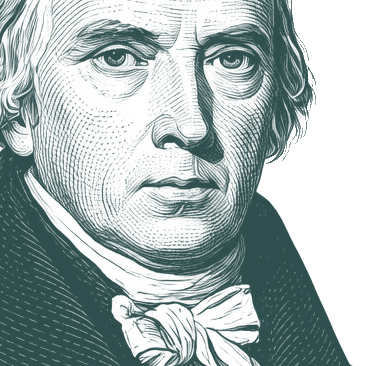
We hold it for a fundamental and undeniable truth, “that Religion or the duty which we owe to our Creator and the Manner of discharging it, can be di… - James Madison
""
We hold it for a fundamental and undeniable truth, “that Religion or the duty which we owe to our Creator and the Manner of discharging it, can be directed only by reason and conviction, not by force or violence.” The Religion then of every man must be left to the conviction and conscience of every man; and it is the right of every man to exercise it as these may dictate. This right is in its nature an unalienable right. It is unalienable; because the opinions of men, depending only on the evidence contemplated by their own minds, cannot follow the dictates of other men: It is unalienable also; because what is here a right towards men, is a duty towards the Creator. It is the duty of every man to render to the Creator such homage, and such only, as he believes to be acceptable to him. This duty is precedent both in order of time and degree of obligation, to the claims of Civil Society. Before any man can be considered as a member of Civil Society, he must be considered as a subject of the Governor of the Universe: And if a member of Civil Society, who enters into any subordinate Association, must always do it with a reservation of his duty to the general authority; much more must every man who becomes a member of any particular Civil Society, do it with a saving of his allegiance to the Universal Sovereign. We maintain therefore that in matters of Religion, no man's right is abridged by the institution of Civil Society, and that Religion is wholly exempt from its cognizance. True it is, that no other rule exists, by which any question which may divide a Society, can be ultimately determined, but the will of the majority; but it is also true, that the majority may trespass on the rights of the minority.
English
Collect this quote
About
James Madison
James Madison Jr. (16 March 1751 – 28 June 1836) was an American statesman, diplomat, and Founding Father who served as the fourth president of the United States from 1809 to 1817. Madison was popularly acclaimed the "Father of the Constitution" for his pivotal role in drafting and promoting the Constitution of the United States and the Bill of Rights.
Biography information from
Wikiquote·
Portrait adapted from
Wikimedia Commons, John Vanderlyn (Public domain / CC0)
Also Known As
Birth Name:
James Madison, Jr.
Alternative Names:
James Madison Jr.
•
President Madison
•
President James Madison
Related quotes. More quotes will automatically load as you scroll down, or you can use the load more buttons.
Shorter versions of this quote
The Religion then of every man must be left to the conviction and conscience of every man; and it is the right of every man to exercise it as these may dictate. This right is in its nature an unalienable right. It is unalienable, because the opinions of men, depending only on the evidence contemplated by their own minds cannot follow the dictates of other men: It is unalienable also, because what is here a right towards men, is a duty towards the Creator. It is the duty of every man to render to the Creator such homage and such only as he believes to be acceptable to him.
It will be of little avail to the people that the laws are made by men of their own choice if the laws be so voluminous that they cannot be read, or so incoherent that they cannot be understood.
In every political society, parties are unavoidable. A difference of interests, real or supposed, is the most natural and fruitful source of them. The great object should be to combat the evil: 1. By establishing a political equality among all. 2. By withholding unnecessary opportunities from a few, to increase the inequality of property, by an immoderate, and especially an unmerited, accumulation of riches. 3. By the silent operation of laws, which, without violating the rights of property, reduce extreme wealth towards a state of mediocrity, and raise extreme indigence towards a state of comfort. 4. By abstaining from measures which operate differently on different interests, and particularly such as favor one interest at the expence of another. 5. By making one party a check on the other, so far as the existence of parties cannot be prevented, nor their views accommodated. If this is not the language of reason, it is that of republicanism.
PREMIUM FEATURE
Advanced Search Filters
Filter search results by source, date, and more with our premium search tools.
I have observed that gentlemen suppose that the general legislature will do every thing mischievous they possibly can, and that they will omit to do every thing good which they are authorized to do. If this were a reasonable supposition, their objections would be good. I consider it reasonable to conclude that they will as readily do their duty as deviate from it; nor do I go on the grounds mentioned by gentlemen on the other side — that we are to place unlimited confidence in them, and expect nothing but the most exalted integrity and sublime virtue. But I go on this great republican principle, that the people will have virtue and intelligence to select men of virtue and wisdom. Is there no virtue among us? If there be not, we are in a wretched situation. No theoretical checks, no form of government, can render us secure. To suppose that any form of government will secure liberty or happiness without any virtue in the people, is a chimerical idea. If there be sufficient virtue and intelligence in the community, it will be exercised in the selection of these men; so that we do not depend on their virtue, or put confidence in our rulers, but in the people who are to choose them.” James Madison (speech at the Virginia Ratifying Convention, 20 June 1788)