When in 1977, the United Nations passed the resolution inaugurating the International Day of Solidarity with the Palestinian people, it was asserting… - Nelson Mandela
""
When in 1977, the United Nations passed the resolution inaugurating the International Day of Solidarity with the Palestinian people, it was asserting the recognition that injustice and gross human rights violations were being perpetrated in Palestine. In the same period, the UN took a strong stand against apartheid; and over the years, an international consensus was built, which helped to bring an end to this iniquitous system.
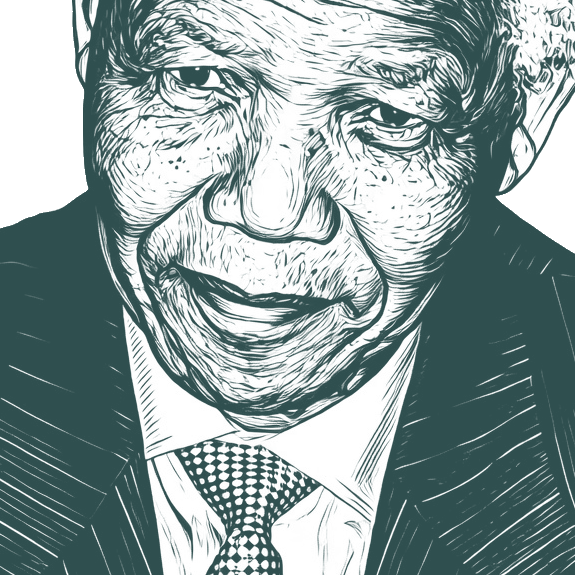
Nelson Rolihlahla Mandela (18 July 1918 – 5 December 2013) was a South African anti-apartheid revolutionary, politician, and philanthropist, who served as President of South Africa from 1994 to 1999. He was the country's first black chief executive, and the first elected in a fully representative democratic election. His government focused on dismantling the legacy of apartheid through tackling institutionalised racism and fostering racial reconciliation. Politically an African nationalist and democratic socialist, he served as President of the African National Congress (ANC) party from 1991 to 1997. He was the co-winner of the Nobel Peace Prize with F.W. de Klerk in 1993.
Biography information from
Wikiquote·
Portrait adapted from
Wikimedia Commons, Kingkongphoto & www.celebrity-photos.com from Laurel (CC BY-SA)
Also Known As
Native Name:
Nelson Rolihlahla Mandela
Alternative Names:
Mandela
•
Prisoner 46664
•
Madiba
•
Rolihllahla
•
Rolihllahla Mandela
•
Father of the Nation
We bow our heads in worship on this day and give thanks to the Almighty for the bounty He has bestowed upon us over the past year. We raise our voices in holy gladness to celebrate the victory of the risen Christ over the terrible forces of death. Easter is a joyful festival! It is a celebration because it is indeed a festival of hope! Easter marks the renewal of life! The triumph of the light of truth over the darkness of falsehood! Easter is a festival of human solidarity, because it celebrates the fulfilment of the Good News! The Good News borne by our risen Messiah who chose not one race, who chose not one country, who chose not one language, who chose not one tribe, who chose all of humankind! Each Easter marks the rebirth of our faith. It marks the victory of our risen Saviour over the torture of the cross and the grave. Our Messiah, who came to us in the form of a mortal man, but who by his suffering and crucifixion attained immortality. Our Messiah, born like an outcast in a stable, and executed like criminal on the cross. Our Messiah, whose life bears testimony to the truth that there is no shame in poverty: Those who should be ashamed are they who impoverish others. Whose life testifies to the truth that there is no shame in being persecuted: Those who should be ashamed are they who persecute others. Whose life proclaims the truth that there is no shame in being conquered: Those who should be ashamed are they who conquer others. Whose life testifies to the truth that there is no shame in being dispossessed: Those who should be ashamed are they who dispossess others. Whose life testifies to the truth that there is no shame in being oppressed: Those who should be ashamed are they who oppress others.”
I cannot conceive of Israel withdrawing if the Arab states do not recognize Israel, within secure borders.
PREMIUM FEATURE
Advanced Search Filters
Filter search results by source, date, and more with our premium search tools.
We know too well that our freedom is incomplete without the freedom of the Palestinians; without the resolution of conflicts in East Timor, the Sudan and other parts of the world.