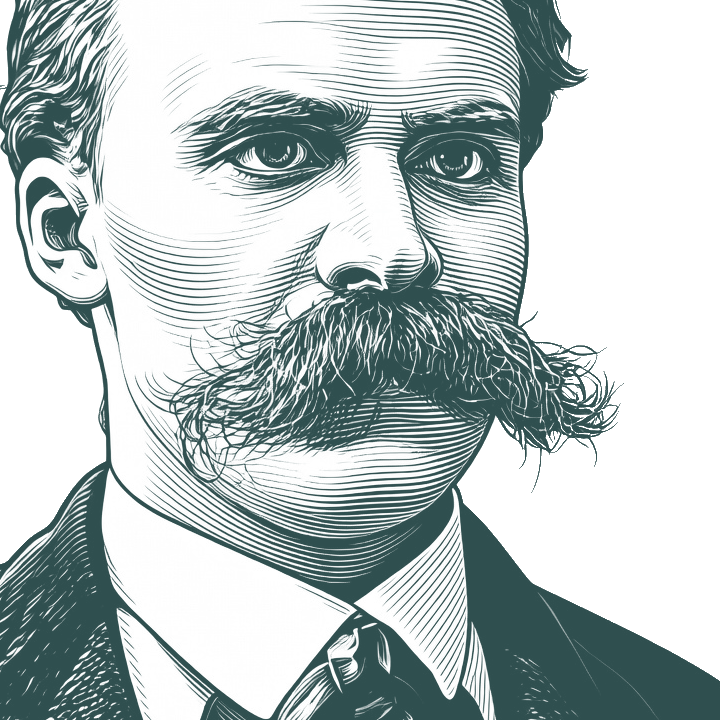
The venerability, reliability, and utility of truth is something which a person demonstrates for himself from the contrast with the liar, whom no one… - Friedrich Nietzsche
""
The venerability, reliability, and utility of truth is something which a person demonstrates for himself from the contrast with the liar, whom no one trusts and everyone excludes. As a "rational" being, he now places his behavior under the control of abstractions. He will no longer tolerate being carried away by sudden impressions, by intuitions.
Friedrich Wilhelm Nietzsche (15 October 1844 – 25 August 1900) was a German philosopher, cultural critic, composer, poet, writer, and philologist whose work has exerted a profound influence on modern intellectual history. His critiques of contemporary culture, religion, and philosophy centered on a basic question regarding the foundation of values and morality.
Biography information from
Wikiquote·
Portrait adapted from
Wikimedia Commons, Friedrich Hermann Hartmann (Public domain / CC0)
Also Known As
Alternative Names:
Friedrich Wilhelm Nietzsche
•
Nietzsche
Only by forgetting this primitive world of metaphor can one live with any repose, security, and consistency: only by means of the petrification and coagulation of a mass of images which originally streamed from the primal faculty of human imagination like a fiery liquid, only in the invincible faith that this sun, this window, this table is a truth in itself, in short, only by forgetting that he himself is an artistically creating subject, does man live with any repose, security, and consistency. If but for an instant he could escape from the prison walls of this faith, his "self consciousness" would be immediately destroyed. It is even a difficult thing for him to admit to himself that the insect or the bird perceives an entirely different world from the one that man does, and that the question of which of these perceptions of the world is the more correct one is quite meaningless, for this would have to have been decided previously in accordance with the criterion of the correct perception, which means, in accordance with a criterion which is not available.
PREMIUM FEATURE
Advanced Search Filters
Filter search results by source, date, and more with our premium search tools.
The Christian Vengeance against Rome. — Perhaps nothing is more fatiguing than the sight of a continual conqueror: for more than two hundred years the world had seen Rome overcoming one nation after another, the circle was closed, all future seemed to be at an end, everything was done with a view to its lasting for all time—yea, when the Empire built anything it was erected with a view to being aere perennius. We, who know only the “melancholy of ruins,” can scarcely understand that totally different melancholy of eternal buildings, from which men endeavoured to save themselves as best they could—with the light-hearted fancy of a Horace, for example. Others sought different consolations for the weariness which was closely akin to despair, against the deadening knowledge that from henceforth all progress of thought and heart would be hopeless, that the huge spider sat everywhere and mercilessly continued to drink all the blood within its reach, no matter where it might spring forth.This mute, century-old hatred of the wearied spectators against Rome, wherever Rome's domination extended, was at length vented in Christianity, which united Rome, “the world,” and “sin” into a single conception.