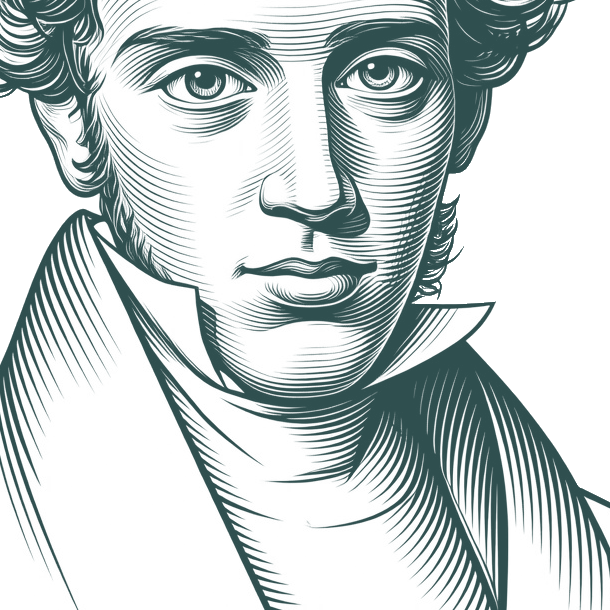
Then faith's paradox is this: that the single individual is higher than the universal, that the single individual determines his relation to the univ… - Søren Kierkegaard
""
Then faith's paradox is this: that the single individual is higher than the universal, that the single individual determines his relation to the universal through his relation to God, not his relation to God through his relation through the universal... Unless this is how it is, faith has no place in existence; and faith is then a temptation.
Søren Aabye Kierkegaard (5 May 1813 – 11 November 1855) was a Danish Christian philosopher and theologian, considered to be a founder of Existentialist thought and Absurdist traditions. He wrote critical texts on organized religion, Christendom, morality, ethics, psychology and philosophy of religion, displaying a fondness for metaphor, irony and parables.
Biography information from
Wikiquote·
Portrait adapted from
Wikimedia Commons, La Biblioteca Real de Dinamarca (Public domain / CC0)
Also Known As
Pen Names:
Victor Eremita
•
A
•
Judge William
•
Johannes de silentio
•
Constantine Constantius
•
Young Man
•
Vigilius Haufniensis
•
Nicolaus Notabene
•
Hilarius Bookbinder
•
Johannes Climacus
•
Inter et Inter
•
H.H.
•
Anti-Climacus
•
B
•
Johannes de Silentio
•
Constantin Constantius
•
P. CH. Kierkegaard
Native Name:
Søren Aabye Kierkegaard
Alternative Names:
Kierkegaard
•
Climacus
•
Sören Aaby Kierkegaard
Between God and man there is and remains an eternal, essential, qualitative difference. The paradoxical relationship (which, quite rightly, cannot be thought, but only believed) appears when God appoints a particular man to divine authority, in relation, be it carefully noted, to that which has entrusted to him.
In eternity it will be asked whether you may not have damaged a good thing, in order that you also might judge with them that did not know how to judge, but who possessed the crowd's strength, which in the temporal sense is significant, but to which eternity is wholly indifferent.
Works in ChatGPT, Claude, or Any AI
Add semantic quote search to your AI assistant via MCP. One command setup.
You have surely noticed among schoolboys, that the one that is regarded by all as the boldest is the one who has no fear of his father, who dares to say to the others, "Do you think I am afraid of him?" On the other hand, if they sense that one of their number is actually and literally afraid of his father, they will readily ridicule him a little. Alas, in men's fear-ridden rushing together into a crowd (for why indeed does a man rush into a crowd except because he is afraid!) there, too, it is a mark of boldness not to be afraid, not even of God. And if someone notes that there is an individual outside the crowd who is really and truly afraid – not of the crowd, but of God, he is sure to be the target of some ridicule. The ridicule is usually glossed over somewhat and it is said: a man should love God.Yes, to be sure, God knows that man's highest consolation is that God is love and that man is permitted to love Him. But let us not become too forward, and foolishly, yes, blasphemously, dismiss the tradition of our fathers, established by God Himself: that really and truly a man should fear God. This fear is known to the man who is himself conscious of being an individual, and thereby is conscious of his eternal responsibility before God.