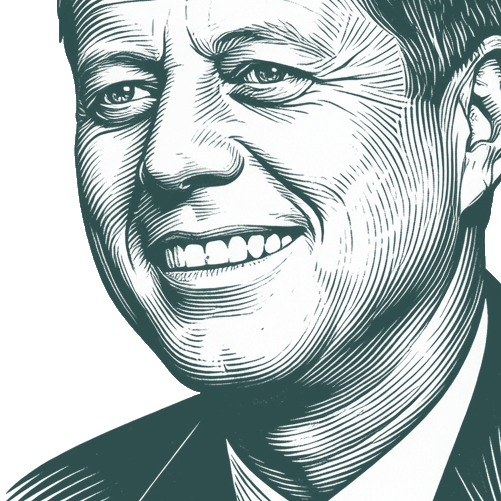
There is no need for us to be satisfied with a rate of growth that keeps good men out of work and good capacity out of use. - John F. Kennedy
""
There is no need for us to be satisfied with a rate of growth that keeps good men out of work and good capacity out of use.
English
Collect this quote
About
John F. Kennedy
John Fitzgerald Kennedy (29 May 1917 – 22 November 1963), often referred to by his initials JFK and Jack, was the 35th president of the United States (1961–1963), a United States senator from Massachusetts (1953–1960), and a United States representative (1947–1953). Kennedy served at the height of the Cold War, and the majority of his work as president concerned relations with the Soviet Union and Cuba. He is the older brother of Robert F. Kennedy and Ted Kennedy, and the first husband of Jacqueline Kennedy Onassis. He was shot in the presence of his wife in Dallas on November 22, 1963.
Portrait adapted from
Wikimedia Commons, Cecil W. Stoughton (Public domain / CC0)
Also Known As
Birth Name:
John Fitzgerald Kennedy
Also Known As:Jack
Alternative Names:
Kennedy
•
Jack Kennedy
•
President Kennedy
•
J. F. Kennedy
•
JFK
•
John Kennedy
•
John Fitzgerald "Jack" Kennedy
•
JF Kennedy
•
John F Kennedy
But history may well remember this as a week for an act of lesser immediate impact, and that is the decision by the United States and the Soviet Union to seek concrete agreements on the joint exploration of space. Experience has taught us that an agreement to negotiate does not always mean a negotiated agreement. But should such a joint effort be realized, its significance could well be tremendous for us all. In terms of space science, our combined knowledge and efforts can benefit the people of all the nations: joint weather satellites to provide more ample warnings against destructive storms--joint communications systems to draw the world more closely together--and cooperation in space medicine research and space tracking operations to speed the day when man will go to the moon and beyond. But the scientific gains from such a joint effort would offer, I believe, less realized returns than the gains for world peace. For a cooperative Soviet-American effort in space science and exploration would emphasize the interests that must unite us, rather than those that always divide us. It offers us an area in which the stale and sterile dogmas of the cold war could be literally left a quarter of a million miles behind. And it would remind us on both sides that knowledge, not hate, is the passkey to the future--that knowledge transcends national antagonisms--that it speaks a universal language--that it is the possession not of a single class, or of a single nation or a single ideology, but of all mankind.
This State, this city, this campus, have stood long for both human rights and human enlightenment — and let that forever be true. This Nation is now engaged in a continuing debate about the rights of a portion of its citizens. This Nation is now engaged in a continuing debate about the rights of a portion of its citizens. That will go on, and those rights will expand until the standard first forged by the Nation's founders has been reached, and all Americans enjoy equal opportunity and liberty under law. But this Nation was not founded solely on the principle of citizens' rights. Equally important, though too often not discussed, is the citizen's responsibility. For our privileges can be no greater than our obligations. The protection of our rights can endure no longer than the performance of our responsibilities. Each can be neglected only at the peril of the other. I speak to you today, therefore, not of your rights as Americans, but of your responsibilities. They are many in number and different in nature. They do not rest with equal weight upon the shoulders of all. Equality of opportunity does not mean equality of responsibility. All Americans must be responsible citizens, but some must be more responsible than others, by virtue of their public or their private position, their role in the family or community, their prospects for the future, or their legacy from the past. Increased responsibility goes with increased ability, for "of those to whom much is given, much is required."
Try QuoteGPT
Chat naturally about what you need. Each answer links back to real quotes with citations.
While the so-called religious issue is necessarily and properly the chief topic here tonight, I want to emphasize from the outset that we have far more critical issues to face in the 1960 election; the spread of Communist influence, until it now festers 90 miles off the coast of Florida — the humiliating treatment of our President and Vice President by those who no longer respect our power — the hungry children I saw in West Virginia, the old people who cannot pay their doctor bills, the families forced to give up their farms — an America with too many slums, with too few schools, and too late to the moon and outer space. These are the real issues which should decide this campaign. And they are not religious issues — for war and hunger and ignorance and despair know no religious barriers.