The modern mind is forced towards the future by a certain sense of fatigue, not unmixed with terror, with which it regards the past. It is propelled … - G. K. Chesterton
""
The modern mind is forced towards the future by a certain sense of fatigue, not unmixed with terror, with which it regards the past. It is propelled towards the coming time; it is, in the exact words of the popular phrase, knocked into the middle of next week. And the goad which drives it on thus eagerly is not an affectation for futurity Futurity does not exist, because it is still future. Rather it is a fear of the past; a fear not merely of the evil in the past, but of the good in the past also. The brain breaks down under the unbearable virtue of mankind. There have been so many flaming faiths that we cannot hold; so many harsh heroisms that we cannot imitate; so many great efforts of monumental building or of military glory which seem to us at once sublime and pathetic. The future is a refuge from the fierce competition of our forefathers. The older generation, not the younger, is knocking at our door. It is agreeable to escape, as Henley said, into the Street of By-and-Bye, where stands the Hostelry of Never. It is pleasant to play with children, especially unborn children. The future is a blank wall on which every man can write his own name as large as he likes; the past I find already covered with illegible scribbles, such as Plato, Isaiah, Shakespeare, Michael Angelo, Napoleon. I can make the future as narrow as myself; the past is obliged to be as broad and turbulent as humanity. And the upshot of this modern attitude is really this: that men invent new ideals because they dare not attempt old ideals. They look forward with enthusiasm, because they are afraid to look back.
Gilbert Keith Chesterton (29 May 1874 – 14 June 1936) was a British writer whose prolific and diverse output included works of philosophy, ontology, poetry, play writing, journalism, public lecturing and debating, literary and art criticism, biography, Christian apologetics (particularly for Catholicism), and fiction, including fantasy and detective fiction. He has been called the "prince of paradox".
Biography information from
Wikiquote·
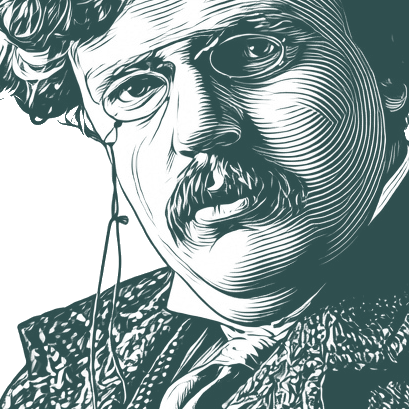
Portrait adapted from
Wikimedia Commons, Ernest Herbert Mills (Public domain / CC0)
Also Known As
Native Name:
Gilbert Keith Chesterton
Alternative Names:
František Kafka
•
Kafka
•
Gilbert K. Chesterton
•
Gilbert Chesterton
•
G.K. Chesterton
•
G. K. C.
Tradition is only democracy extended through time. It is trusting to a consensus of common human voices rather than to some isolated or arbitrary record... Tradition means giving votes to the most obscure of all classes, our ancestors. It is the democracy of the dead. Tradition refuses to submit to the small and arrogant oligarchy of those who merely happen to be walking about. All democrats object to men being disqualified by the accident of birth; tradition objects to their being disqualified by the accident of death. Democracy tells us not to neglect a good man’s opinion, even if he is our groom [butler]; tradition asks us not to neglect a good man’s opinion, even if he is our father.
Thieves respect property; they merely wish the property to become their property that they may more perfectly respect it.
PREMIUM FEATURE
Advanced Search Filters
Filter search results by source, date, and more with our premium search tools.
Now there is any amount of this nonsense cropping up among American cranks. Anybody may propose to establish coercive Eugenics; or enforce psychoanalysis — that is, enforce confession without absolution.